Murgab, Tajikistan

The drive from Lake Karakul took us up over the Ak Baital (White Horse) Pass at 4655m. We continued to follow the military fence and saw several herders with their yaks. Passed many derelict pre-Soviet and Soviet military ruins along the way.


Murgab has a huge military base. The houses are square with flat roofs and very few trees. We visited the bazaar which is a clutter of old shabby containers. We topped up the sim card we were given by a German couple and it took so long as he gave us a gigabyte and had to register each 100 megabyte voucher individually my phone.


Murgab, population 6500, is the hometown for our driver Turat. He works everyday he can driving tourists about in the summer and sits at home smoking and sleeping all winter as the temperatures drop to minus 45 C. Many of the Pamir Highway drivers come from Murgab. Usually he would homestay his guests at his house but his wife is in Bishkek visiting their first grandchild so he could not host us.

We walked around the town and watched the kids gathering up their goats, sheep, and cows to lock them back up in the house courtyards overnight. There is a large modern hotel with a yurt out front in town. There were several motorbikes and bicycles parked outside belonging to the fit and adventurous travellers.

There was a large depot for Chinese long haul trucks bringing in supplies from China. Sadly the trucks return empty to China. Turat told us that the eggs in the Osh bazaar come from China.

The homestay ladies took three hours to light the fire to heat the water for a shower and it was like a Russian banya. The room was tiled and steamy hot. One tap had boiling hot water and the other cold so we would mix the two and bucket it over ourselves. There were no birch leaves to lash us though.


Water was stored in the big blue drums at the homestay.

We slept in a huge room with enormous couches that must have been put into the room before the windows as they were so huge. John slept on one and I took a hard lumpy mattress on the floor. Mark was in another room across from us and the space in between had a table and chairs and this was where we ate our dinner. We had a watery soup followed by a plate of fried yak meat and nothing else - we were told this was the national dish.

The ladies had trouble getting the generator going at night to give us lights. A large group of travellers arrived in the dark and were housed in the main building away from us so we never got to chat with them.

Turat came by in the morning and was not impressed with how unfriendly the ladies were and gave them a lecture about smiling for their guests. He can't wait for his wife to come back and host his clients.

Lake Karakul, Tajikistan

On the way to the Tajikistan border we first stopped at Sary Tash so Turat could have lunch. Mark had visited the place a few years ago and could see a few changes with more houses in the area.


Sary Tash


Lunch stop. Met a group of Dutch cyclist here too.


Climbing up with a view through the cracked windscreen.

At the top of the Kyzyl Pass were a couple of  children all rugged up and picking flowers. They gave us some and posed for a photo for us. We were not sure what they were doing in such a cold windy place as there were no other adults about.


Our first overnight stop with Turat on our Pamir highway trip was Lake Karakul. It was created by a meteor impact over ten million years ago so has no outlet for the water. It is also pretty salty. There is an island in the middle of the lake.


We pulled up to a homestay and there were several other 4x4 vehicles there too.


We met a young Swedish lady and her male friend. They were training everyday to swim the lake and run the island as the lake is higher than Lake Titicaca. A few days later a sailing regatta was due to begin on the lake and they would do their run during that. They showed us a calendar promoting the regatta and there were photos of windsurfers on the lake. (PS: we never saw any news of how the regatta or run/swim went.)
Mechanical workshop

We walked around the town but it was pretty deserted. Some houses had their windows boarded up and the front doors barricaded with huge rocks.


The families were probably away in the meadow lands with their animals and not returning until October.
Weather station

Mark, Turat John and I slept on mattresses in a huge room. In the morning Mark had left due to John and Turat's snoring! The room had a huge wooden cabinet with gold decorated plates and cups that looked like wedding presents. Each group of travellers had their own rooms and the drivers slept in the dining room.The house had electricity and and satellite TV. The toilet was outside and the shower in the courtyard.
Animal dung fuel drying

We had a hot breakfast of porridge made from rice and cooked in milk and caught up with all the other guests plans. An elderly French couple were heading out to Osh and we were heading in the opposite direction.


Osh, Kyrgyzstan

We caught the 12.30 Mercedes Sprinter at the Arslanbob square and found it full of mostly tourists, Germans, Poles and Belgians. We passed through a suburb of newly built but not completed houses outside town and were reminded that lots of people from the area go to Russia to work and send the money home to build these fancy places.

At the Osh bus terminal we had a hard time finding a short distance taxi to take us to the guesthouse we had booked in the middle of the city. After approaching a few drivers we managed to find one to drive us and a Belgian couple to the city.

Our guest house was a complete apartment with a small kitchen, large lounge and a washing machine above a garage. The Belgians decided that the only other apartment available was too expensive for them so they headed off to a hotel across town that was owned by the guesthouse owner's neighbour.


Osh has 3000 years of history, with locals claiming it is older than Rome. Legends tell of all sorts of people in its founding from King Solomon to Alexander the Great. As you arrive in the city you can see the huge five peaked rock looming above it. A pretty spectacular landmark in a place that has been a Silk Road hub from its earliest days.


We got up early one day and walked up to the mosque at the bottom of the crag and were directed by some young lads to a  trail that took us up through the Muslim cemetery. Although the sign said it was the main trail we could see it was overgrown, rocky and steep but followed it anyway. It got us to the top where we saw young girls sliding down a part of the healing rock which is supposed to help fertility. Various caves and parts of the rock are visited to heal other kinds of ailments. Suleiman Too has been a place of Muslim pilgrimage for centuries. On the way down we realised we had missed the official entrance and cashier.

Near the bottom was a silver Dalek-like dome that was locked up but we could peer in the doorway and see it had a stage and backdrops that brides would visit to have their photographs taken of places that they had never been.


We bumped into a Dutch guy who was on a tour with some alpinists to climb Lenin Peak at 7000 m. Unfortunately his boots got wet during the acclimatisation camp and bruised his toes so he had to spend his days wandering around Osh instead.

We were the only visitors to the National Museum and it was nice to be out of the 35 DegC heat and check out the history of Osh.

We have made arrangements online to meet a Kyrgyz man called Turat. He will be our driver for eleven days on the Pamir Highway and through the Wakhan Valley and then onto Dushanbe in Tajikistan. The 56 year old has been driving tourists for twenty odd years in his Landcruiser. We decided to offer a seat to a lone traveller so advertised it on Indyguide.com as it is expensive for a single person to hire a driver. We could have taken more people but decided we wanted to be comfortable as well. When we checked our emails we had had a reply from a 42 year old English guy called Mark.

We met Mark at a nearby restaurant where we had eaten the evening before. We sorted out the details of the trip and were all in agreement about the trip and just as we were about to order our meals after a beer we were told by a waiter that the cook had fallen in the kitchen and was rushed to hospital so there would be no meals for us. We headed down the road to find another place to eat and get to know each other. This place seemed very popular for Osh families with money, as it was quite expensive and had a playground in the middle and lots of Mercedes and BMWs outside.

 Anyone for cow legs?

We visited the huge Osh market for tomatoes and cucumbers for the trip and with the help of our Google translator were able to find some white spirits for our MSR cooker.


Saw a group of boys playing with huge cow knuckle bones the same way we would have played with marbles when we were kids. Their male relatives nearby were drinking some kind of alcohol and wanted to pose for our camera.


The bazaar is one of the largest in Central Asia. Some stalls were for men to play in billiard competitions. It was a higgledy piggledy place of stalls and converted containers selling everything you would want.

Baby rocking cots
Baby cots with covers

Around the corner from our guesthouse was a supermarket with flashing neon lights that was open 24 hours a day and we were able to get bread, cheese and snacks for our trip. On the way out of town, our first stop was the money changer near the bazaar to exchange our Kyrgyz som for Tajikistan somoni.

As we headed out of Osh Turat asked several times if we had any problems with altitude sickness. I had persuaded my doctor to give me diamox as a preventer for altitude sickness and had given Mark some as well. He told us that recently a young Norwegian lady had to be airlifted by an American helicopter off the highway as she was seriously affected.

We headed up the Taldyk Pass at 3615m to Sary Tash via Gulcha. The small border town was a good stop for a snack and tea.

We had an easy crossing to Tajikistan as Turat presented our e-visas and passports to immigration. We didn't have to get out of the vehicle. There was a long military fence along the eastern side of the highway designating the neutral zone between Tajikistan and China.


We continued up Kyzyl-Art Pass at 4282m with great mountain views. John said he counted about 25 4x4 vehicles on the highway as well as many cyclists crawling up the passes. There was a lone female trying to hitch a ride on the misty, cold, wet road. Some people want to travel without spending any money and see no problem with putting themselves in such predicaments. Most of the passing vehicles were hired by tourists and their drivers do not stop for anyone. A few vans were shared taxis but they are always full before they leave for their destinations.

Next stop Karakul, Tajikistan.


Arslanbob, Kyrgyzstan

At the Jalalabad taxi stop the local taxi drivers wanted ten times the local price for a taxi to Arslanbob but we found the local shared mushrukta and took that to a junction where we found a Sprinter to take us the rest of the way. The Sprinter even had a price list for all the destinations it travelled to so that was helpful.

Arslanbob is situated at 1660m above sea level with an impressive wall of snow clad peaks around it. It is situated in a fertile river valley. The town of 30,000 people are ethnically Uzbek people. When Russian divided up its states it didn't take into account the ethnicity of the inhabitants. The area is surrounded by the world's largest walnut forest.


After being dropped off in the main square we followed the signs for the CBT office which was closed but a local told us to wait and he would call the coordinator to open up. The coordinator said they take turns manning the office and rang Ibrahim, a homestay owner. Ibraham is a 62 year old man who teaches German at the local school. He planned to retire in September as he is finding the children tire him these days. Ibrahim's wife was a geography teacher.


We piled into his old Russian Lada and we wound up the rocky road to his place. He had three buildings for guests on the site. There were two rooms where he put us and they opened onto a platform with a low table. There was a hot shower behind the rooms. The second building he had had two beds in a long room. Part of his own house had a room for guests as well. He had a western style sit down toilet as well as a squat one that was at the far end of the main house. Between the buildings was a huge flower garden, his wife's passion.

Ibraham's son, his wife and two children lived with him. The daughter in law was always first up. She would sweep the walkways and fill the washing machine with clothes and hand wash those that didn't fit in and she would be at it on and off all day. She would chop wood for the outdoor kitchen to cook the family's food and prepare it. She would make us tea and bake bread. She never spoke and although she was a beautiful looking woman we never saw her smile. We felt very sorry for the daughter in law.

The son helped the dad line the outdoor kitchen with a plastic lining on the ceiling to make it easier to clean and more presentable that the old black sooty rough sawn timber ceiling.

In the evening the whole family slept in one room on the floor on thin mattresses.

Ibrahaim gave us a menu of meals we could have in the evening, as board included breakfast and dinner. My favourite Kyrgyz dish is dimlama. It is a stew with a little mutton stewed slowly in a broth with cabbage, potatoes, sweet peppers and carrots. Watermelons are everywhere now so we had some after our meal. One night we had laagman, which is a broth with potato and carrots and noodles, this was the American guest's favourite pick from the menu  - so each night we have to agree with the other guests what the meal will be and we need to order it at breakfast time.


We managed to get all our washing done and spent some time walking around the sights of the town. One of the main attractions is a small waterfall. We headed off there using Google maps as none of the streets have names or signs. On the way to the falls are rows of stalls made of bits of timber, plastic and fabric. They sell soft drinks, trinkets, cheap plastic toys, dried yoghurt balls, dried fruits and nuts. Between the stalls are 'hit the balloons with a dart and win a stuffed toy' games. The head scarfed young girls like to try their hand giggling their way through toss of the dart. They are such fun to watch as they have so much fun out of such a simple game. The boys however prefer to use have a go at the shooting gallery.


There seemed to be a fee to take a walkway to the other side of the waterfall to a restaurant where you could pose under a heart shaped arch but we could see a path in the hills behind so we decided to head there and find the panoramic view that Ibrahim had told us to visit. We made it to the top and could see the walnut forest and town and watched as some tourists explored with horses and guides. Unfortunately the top of Babash Ata mountains were covered in cloud.


Another time we visited the local town market day. People came from all parts of the valley to buy the meat hanging in the stalls, vegies, fruit, bread, clothes and shoes from China and other goods. The place was packed. and cars jammed up the small main square.


Arslanbob has an amusement park called Turbaza, a Soviet era holiday camp.


What a great place for people watching.


There were more pop the balloons with darts as well as a pirate swing,


Ferris wheels, quad bike rides, punch ball machines that rate your punch,


Children's trains, a mini hovercraft and a swimming pool. Only boys were swimming in the cold cloudy river water and then trying to warm up on the rocky ground.


The most interesting place was a huge caged dance pavilion. The young girls huddled together dancing while the young men in clean tight clothes and sunglasses watched from outside. When there was someone they fancied they paid their money and went in showing off their moves to the mostly disinterested young ladies. The parents sat outside watching all the goings on.

A German couple who had taken a year off work arrived at the guest house and they had come from Tajikistan and Uzbekistan. We enjoyed chatting to them and they gave us their old sim cards for our travels which was great. Ibrahim also enjoyed speaking German with them and was excited to tell us all that the German ambassador and a couple of staff members were coming to his guest house in the next few days.

Only two marshruktas go direct from Arslanbob to Osh - we took the second one at 12.30.


Jalalabad, Kyrgyzstan

The weather cleared in the morning as we all had breakfast together. The Swiss lady told us how they had driven through Iran and enjoyed it so much they spent two months there. They met a lot of friendly people and enjoyed the food and parties they go invited too. All women in Iran must wear a headscarf in public, including tourists. But once they are behind closed doors they can do what they like. As they were crossing the border into Turkmenistan she found that she could enter but her Belgian partner was refused entry. He had to fly to Kyrgyzstan to wait for her to drive their Landrover through. It is very difficult to get visas for Turkmenistan, and you have to either get a five day transit visa which does not require a guide or you have to join a tour with a guide.

After a breakfast of 'kasha' or porridge, and in this case semolina which is a bit like baby food, the rain stopped and we set off in the Sprinter with guides Vasil and Amelia, driver, Sam and Tony. It was interesting to hear about Sam's life working in Delhi, Nepal, and Thailand. Once Sam's contract finishes in Thailand she thinks she will work in Sri Lanka. Tony took early retirement from the travel industry and tags along when he can on Sam's excursions.


The roads are really bad and in the Sprinter we were tossed around quite a bit. It was more comfortable in Kustam's Audi on the potholes and gravel. The poor people who would have to sit in the back seat of the Sprinter would certainly want to move seats each day.

The weather cleared as we climbed over a 3016m pass. There was a wall of snow on one side of the road where the sun had not managed to melt.


 We climbed out of the Sprinter to look down the valley at the zigzag road and met an Audi full of locals. A man called everyone over and chopped up a cantelope for us to eat. He grew them and had brought his family up to visit some relatives in the valley who were living in their yurts and grazing their animals.

Further down the valley there were crops of sunflowers, corn and potatoes. We saw lots of beehives beside the fields as well.


We stopped near a stream and the guides set up a table and folding chairs under a tree. Vasil had included some Kyrgyz bubbles in the shopping and we had a glass with our lunch of cucumber and tomato salad, canned mackeral, cheese, and bread, biscuits and chocolate, fresh plums, grapes and apples. Quite a treat.


When we arrived near Jalalabad we saw lots of recently built houses with corrugated iron roofs and baked brick walls. Many had bricks in the windows and were not finished. Amelia said they were built by Kyrgyz people working overseas. They would send the money home and build such places. She said they were letting everyone know that they had made money overseas and they were to show off their wealth.

Once in Jalalabad the driver and guides flagged down a motorist and negotiated a rate for him to take us to the CBT office in the town centre. They all continued on for another four hours or so.

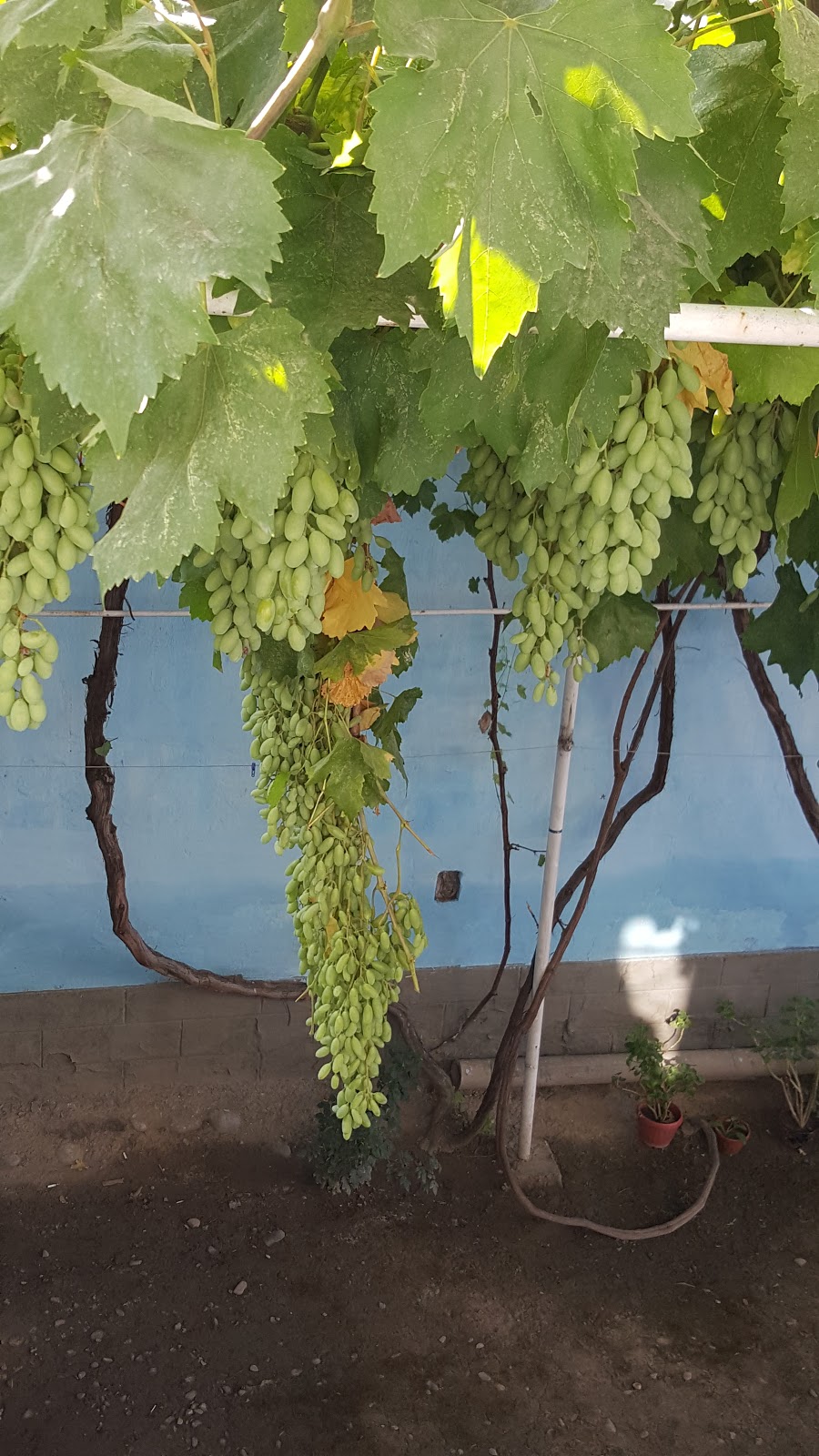
At the CBT office were several young men sitting in front of computers. The office doubled as a media and print office and they phoned the coordinator for us to find a home stay. Before too long a young man arrived and we followed him a few streets away to his family home. No one spoke English. We were taken upstairs to a large room with about four beds in it overlooking a hard earth courtyard. Grapes weaved their way up a trellis to the second floor and had the longest bunches of grapes I have ever seen.


The toilet was at one end of the courtyard while the shower was at the other end through the family's living area. The husband organised tea, bread and jam for us. Some chickens lived under a wall to one side of the courtyard and would cluck away whenever we went past.

After cleaning up we walked into the main street to find somewhere to eat. We found a place that was set back off the street with little wooden booths along one wall and wooden tables in the middle. Lots of families with their children were eating and business men with their cellphones sprawled out on the booth benches drinking tea after work. We ordered  a couple of handles of draught beer before our sizzling chicken and vegetable dish arrived on a hot cast iron plate on a board. A nice change from plov and mutton!

In the morning the husband organised our breakfast of fried eggs and bread and lead us to a back street where we could catch a small bus to the shared taxi depot for our ride to Arslanbob.


Naryn to Kazarman, Kyrgyzstan

Kustam did not speak much English but he managed to tell us he had seven children and a couple of grandchildren. We had to pay him about $110 NZ for the trip as well as pay for his meals and night's accommodation at the other end. He was then free to find more fare paying passengers for his return journey. The CBT office had let other travellers know that we had hired a car and they could join us if they wanted to share the costs but no one was about when we were due to leave.

The road from Naryn to Kazarman is closed from October to late June as it is an unpaved mountainous road and can be impassable at times due to rock and mudslides.

We had to make a huge detour, as part of a bridge had collapsed and was under repair. Luckily Kustam already knew about the problem.


The road was really rough and at times on the passes we were in misty clouds. We only saw a few cars and they were well loaded up with people. Most of the cars were also Audis.

There was a lot of subsistence farming and a few state farms in the bottom of the fertile valleys.

Kustam stopped at a small town of about 600 people where he knocked on the door of a closed shop. Soon a young man came out and motioned us to come into the house. A young 21 year old mother , Natalia, greeted us in English and moved her 3 month old baby in its rocking cradle into the corner of the room. She cleaned up and set the table for lunch for us. She sliced up a huge round of home made bread and fried up some eggs from her chickens. Kustam liked to point out that everything including the salad vegetables were home grown and not from China.

Natalia said she had learnt English at her local school and we were impressed with how well she spoke. While we ate lunch the television was on ,showing a presenter talking to three musicians playing traditional musical instruments and singing local songs.

We saw four cyclists struggling up the gravel roads and four motor bikers. A convoy of German registered 4x4s also roared passed us. As we neared Kazarman we saw two hikers with huge backpacks walking towards us. If they were trying to hitch a ride they would have to be very lucky as there was not much traffic on the road and the cars we saw were well loaded up.

Kustam delivered us to the Kazarman CBT coordinator's house. Bujumal telephoned some of the other CBT homestays to find us a room but no one was available so we stayed with her. A Mercedes Sprinter van arrived at the same time as us and on board were Sam and her husband Tony, two guides and their driver. We had met them when they were photographing a switchback that we had both travelled up and stopped to look back at.

Sam worked for a travel company in Bangkok and was doing a familiarisation trip in preparation for a VIP group that was due to come through a few days later.

Bujumal settled us into our rooms and prepared dinner for us all so it was nice to sit and chat and share some of Tony's vodka. A couple in their own Landrover Defender arrived at dinnertime to join us too. She was Swiss and her partner Belgian and they were coming to the end of a six month road trip.

Bujumal was a local teacher and had a huge vegetable garden from which she sourced some of the ingredients for our plov- rice meal. We ate outside undercover while the rain gently drizzled down.

In the morning we had semolina for breakfast and John asked Sam if we could hitch a ride with them onto Jalalabad. The guides checked with their bosses and the driver with his and in the end they said it was fine as they had enough seats in the Mercedes Sprinter.

Before we could leave we had to drive around the streets looking for a tyre shop to put some air in the Sprinter tyres. Everything was closed and it took a long time to finally find someone to help out.

Next stop Jalalabad, Kyrgyzstan.


Naryn, Kyrgyzstan

Found a shared taxi to Naryn that filled up in no time. We continued along the same road we had returned from Song Kol on. The taxi driver wanted to take us on to Kazarman but his prices were too high. John headed off from the bus stop to talk to the people at the Community Based Tourism (CBT) office to see what they had on offer.


The CBT office was very well organised with a place for people to wait while others were being helped. They had maps and a message board, as well as place for storing backpacks. They organised a homestay for us and a driver to take us to Kazarman the next day. The road to Kazarman is really bad and usually only opens up in June after winter so once we were sure it was open we confirmed with the driver.

The accommodation was a short taxi ride from town. It was a brand new place with four bedrooms each with tits own ensuites. The owner had travelled a lot and spent two years chatting online to a guy in Australia before moving there and getting married. She had a two year old daughter but never mentioned the husband.


She had plans to extend the guest house by adding a two-storey building and a communal area for guests to mingle. She even wanted to build a small gym. I don't know that many travellers would interested in such a gym as they would only be passing through. 


We ate a dinner of plov-rice with mutton, tomato and cucumber salad and bread. We joined the family in their kitchen/dining room. The owner had two teen sons to a previous relationship and they chatted to us. One was studying IT in Bishkek but had come home to help his mum. The owner's sister and her husband and two young children came in and out to check on us. We learnt the sister's husband worked for the governor as a second assistant responsible for the payments from the farmers who graze the state lands. The farmers have to pay according to how much stock they are grazing. The owner's mother joined us too but did not have anything to add or join in.


There is not much to see or do in Naryn but we managed to find a bank that would give us some US dollars. We walked the length of the town which had a lot of blocks of Soviet built apartments in varying degrees of decay. One side of the town is hemmed in by a giant cliff of red while the other side is covered with green pasture.

The CBT driver Kustam, met us after our in-room breakfast and we headed off in his Audi to Kazarman.

Singapore

The Singapore Airlines flight was quite bumpy and after seven and a half hours we arrived in Singapore surprisingly earlier than expected. ...