Ashgabat, 2017 Asian Indoor and Martial Arts Games

A bonus of joining the Young Pioneer Tours (YPT) group to Turkmenistan was to be able to attend the games that we had never ever heard of. The country promoted the opening ceremony to be greater than the Beijing Olympics one. That got everyone curious for sure. To get tickets, all the tour participants, seven of us,  had to select from the the sports those they did not want to go to and those they wouldn't mind attending. Our leaders then chose tickets based on the days we would attend and the events wanted by the most people.We knew we would see the opening ceremony and that we would not be in the country for the closing one but hoped we didn't get tickets for the chess or the E-games!

The staff at our hotel encouraged us to wear our Turkmen hats everyday of the games giving me bobby pins to keep mine attached to my head. The women wear plaits under them so I did the same to look the part as the high school students do wearing theirs.

We left the hotel at 4pm and as before many roads were closed and we took ages to find alternative routes to the games. The security checkpoints were chaotic being the first day. Bags were checked for deodorants, lighters and sharp objects. Our tickets gave us a seating area to go to but no seat numbers. When we arrived at our bay it was full with government workers and university students all dressed the same waving flags. Other seats were full of accredited visitors being coaches, and team supporters and their families so there was no where for us to sit. Nadine, the minder, rang her boss from the Tourism department and she got security to move some of the students so we could have seats. It was chaotic as a couple more tourists and their families arrived and also could not sit down. Eventually they were given seats and the reluctant students wandered off to find another spot.

Waiting for sunset

 The locals had been told to be seated from lunchtime. The sun streamed into our bay and it got really hot.

Approaching the main stadium with the monorail to the left which was only for athletes and spent most of the time running empty. Note the horse head lamp poles.

This eight pointed star is a national symbol found everywhere.

The ceremony started at 20.17 which had some kind of significance but we don't know wha,t other than that is the year. There were thousands of dancers, lots of horses and caravans of camels. What a spectacle! The President sat on the far side of the stadium from us and so the displays were choreographed with him in mind.  It has the capacity for 45,000.


Floating above us were these bicycles during the display of all the sports.


The NZ flag but no team!

A giant Turkman hero

The central screen ready to display images of the history of the country

A huge central screen dropped down in the middle of the stadium and scenes were projected on it. A hole opened in the middle of the ground and a oil and gas factory model popped up. A crater opened up and flames exploded representing the Darvaza Crater.


The President loves horses and Turkmenistan has a unique breed of horse. At the Olympic flame lighting time a tower with a spiral path came out of the ground and a beautiful horse and rider reared up with the torch to light the star symbol above and send a flame speeding across the stadium to the cauldron on top of the horses head outside. Amazing stuff!


Check out this link of the ceremony.

Sixty three nations took part and Oceania was invited to take part for the first time. Australia had sixteen participants in four events. Someone carried the NZ flag but we were not in any events so don't know what happened there.

4012 athletes took part.

There were 339 events and 21 sports represented.

Thirty new structures were especially built by a Turkish company at a cost of $5 billion dollars US. they will be used by the national institutes and universities after the games.


Firstly, we attended the indoor athletics venue and saw the start of the women's pentathlon, some hurdles and some middle distance races. In the lunch break we were able to got o the Berkarar Mall for lunch.
Horses at Berkarar

More Berkarar gold and marble

At lunch we met up with a Catalonian Spanish woman who worked for an agency employing production and choreography staff. She told us about the many headaches of getting the opening ceremony together. It was very interesting. After the closing ceremony she was having one day off and then onto another production in Dubai.


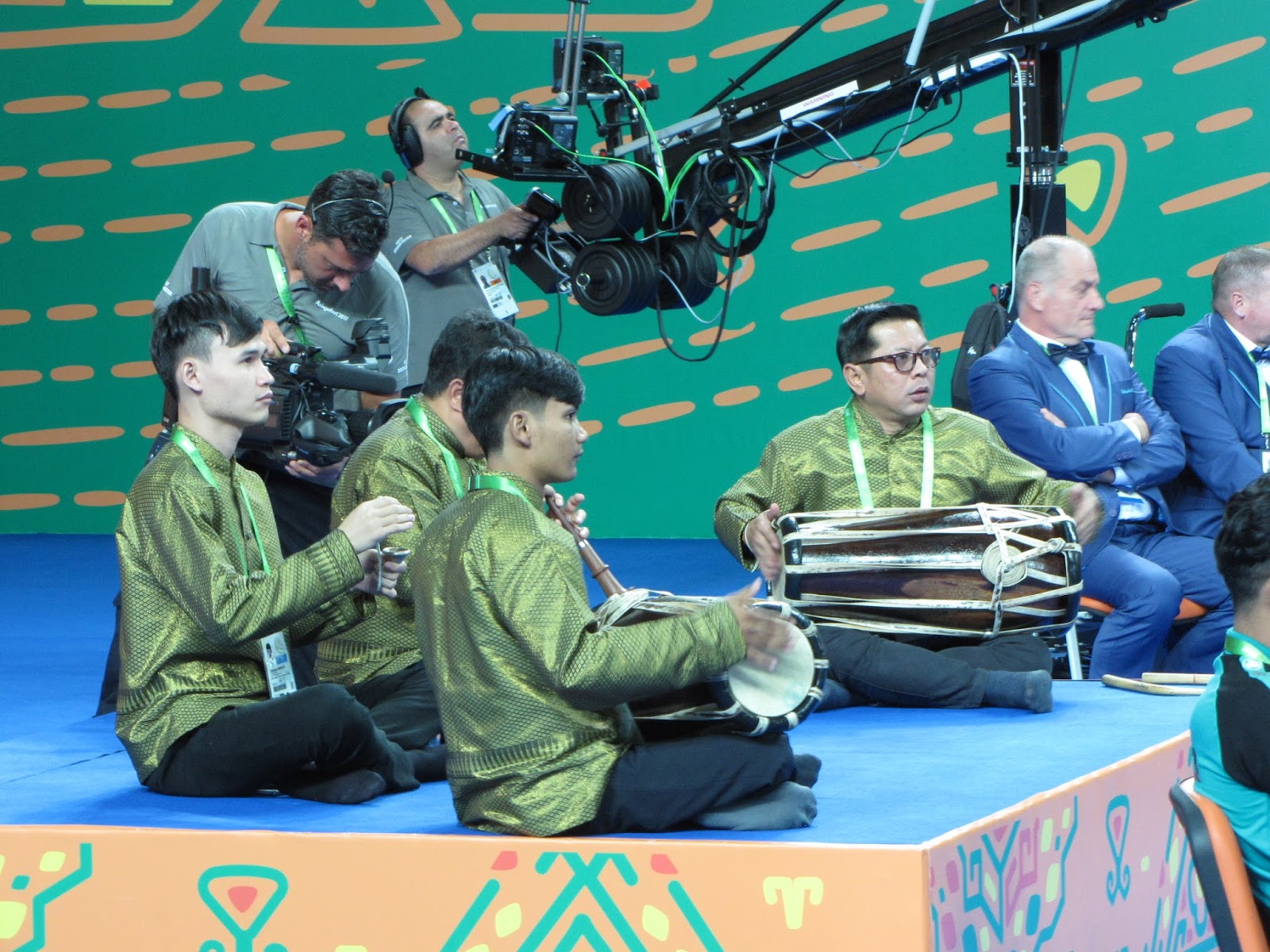
It was the first time we have seen Muay Thai and luckily the first bout included the Asian champion. He was so graceful and fearless, swaying in time to the beat of the accompanying band of drummers, a whistler and a bell ringer. It was a pleasure to watch and when other not so accomplished guys fought you could see how cumbersome and lacking in discipline they were.


Loads of fountains around the stadium

In the break some of our group wandered off to check out the rest of the venue and ended up being ushered into the media lounge to help themselves to coffee and food on offer to accredited guests. I guess we all look alike.

We had evening tickets to the men's 750m cycling sprints. They went from qualifying races to the medal ceremony. Other than watching all the goings on, in the teams areas with warm ups and lots of undressing in the middle of the stadium, it was a pretty slow event. Luckily for us Dutch Tom was able to point out some of the more interesting aspects of sprint racing for us.


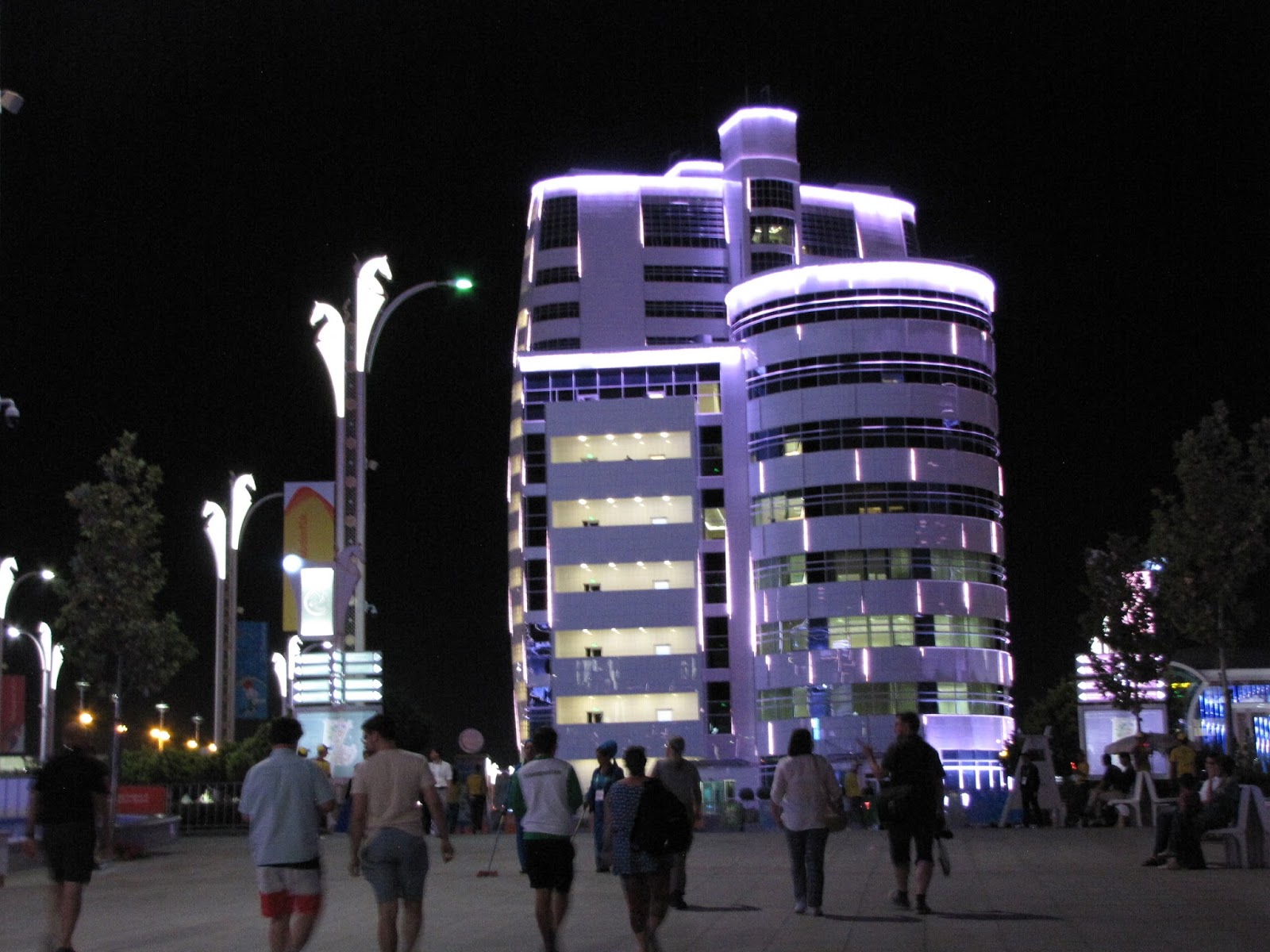
Everything is lit up at night around the stadium

The booers at the tennis!

The most fun time we had was at the indoor tennis. An Indonesian guy was playing a local and there were no people in the stadium supporting him. Whenever the local scored a point the audience would clap and do nothing when the Indonesian scored. Sporty Andrew decided that we should support Davood Susanto and so we made up chants accompanied by clapping. When there was a pause we stood up and enthusiastically performed. When we finished the whole stadium of Turkmen booed us. Undeterred we continued coming up with more and more songs and chants to egg the losing Davood on. The television cameras came to film our fine moments and the locals got in some laughs and stopped  hassling us. In the last few sets a small group of Indonesians came to support him at the far end of the court. Davood won the match so we raced down to the court for selfies and more TV exposure. When we got back to the hotel the staff were so excited to see us on TV.


The women's jiu jitsu event was a strange affair for us and the first time to see the martial art. They seemed to wrap each other up and wobble in a ball of hands and feet for a few minutes and then leap up and hug each other. We didn't get it at all.


The evening event was 3x3 basket ball in a small outdoor area. It was fast and furious keeping us well entertained to the medal ceremony. The small players were fascinating to watch contrasting against the slower moving tall ones, like wind up toys!

Local women

At the end of the evening a lot of the locals had already left and we wandered about the empty facility. It was a weird feeling being at a huge event and then only seeing security personnel and no other attendees. As all the workers and students were obligated to attend and it was difficult to get visas unless on a tour, there were hardly any people who had actually just come for the games who were not media or supporters.


What is the significance of Mr Park and his accredited pass? Our very clever Andrew worked out that these contained the information needed to access the free Wifi in the stadium. He took a guess at the password being Ashgabat 2017 and everyone logged on as Mr Park.

The gang!


Ashgabat, Turkmenistan

On the road to Ashgabat there were many manned police towers. A stop sign in front of them meant a photo could be taken of the car before it could proceed on its journey. At a police check point just outside the city cars were stopped and their boots checked. Our Landcruiser was stopped but not checked.

The roads into the city were new, clean and dual carriageways. We stopped at a leafy suburb at the Ak Altyn hotel, which in Soviet times was the Sheraton or Hilton. Eilidh (pronounced aylee) and Ben from Young Pioneer Tours were there to meet us. She from Scotland and he from Melbourne. Our room was enormous with two bathrooms, a board table and chandeliers. Eilidh said tour groups had never been given rooms on the lower floors as they were reserved for locals but with so many foreigners in the city for the games all floors were occupied.

The hotel

Ben was able to change our US cash forTurkmen manat through the black market as it is a better rate than the banks.

The hotel had a pool and bar, as well as a garden bar, and karaoke bar. Downstairs was a night club that Ben said was really a hangout for prostitutes. It was closed the whole of our stay for renovations.

There were four or five motor homes in the hotel car park travelling in convoy from Germany and Switzerland. Later a couple of huge overland trucks from Dragoman Tour company arrived with elderly folk joining their tour here and then going on into Iran or Azerbaijan. The tours did not have time to go to the games and were just transiting the country.

The circus building from our hotel window

From our room we could see the circus building and beside us was a small restaurant in the ground floor of an old Soviet residential block. We chose to go there for a pizza and asked if they had beer after finding the prices at the hotel really expensive. Having been told there was a ban on alcohol we were surprised when we were told some was arriving in an hour. On the hour a keg arrived in the boot of a car and we were served an ice cold beer.

The President was a doctor and Minister of Health in the previous government so he has continued the ban on cigarette smoking, set by the previous government. We were advised cigarettes were a good gift for our guides and we were only able to import fourty individual cigarettes each. Elderly smokers who could not stop were able to get a certificate from their doctor allowing them to smoke. There is a huge black market for cigarettes now. Both our tour leaders and our Turkmen minder Nadine, were smokers.

We have had a good start start to the country, being able to use blocked web sites, import cigarettes, drink banned beer, and get money at a better rate than the banks give!

Two Dutch guys, Ben and Coen, joined us one morning and with our leaders and minder we did a sightseeing tour of the city. Ashgabat is often called the White City as it has so many white marble buildings.

Ashgabat was a Russian frontier town on the Trans-Caspian railway. In 1948 the city was levelled by a 9.0 Richter scale earthquake, killing more than two-thirds of the population, about 100,000 people.
There ware now many cranes about the city knocking down old buildings and rebuilding and lots had already been done for the 5th Asian Indoor and Martial Arts games. The games are organised by the Asian branch of the International Olympic committee. To qualify to host the games the city needed to have a million inhabitants so as the city only had half a million residents the city boundary was extended and made it by 23 people! The whole county has a population of between 5.1 and 6. million.

 The Earthquake Memorial was built by the previous President as he was made an orphan having lost all his family in the 1948 quake.


We drove to an enormous entertainment and amusement complex where we had a ride on the world's largest indoor Ferris wheel and were the only ones visiting the whole complex.


Andrew managed to persuade everyone that the bumper cars would be a great fun activity for the group, so we were all in. The area was a bit small for all of us and the staff had trouble getting the cars to run continuously. They didn't seem to know how to operate them. The males in our group also raced the video game cars and tried to beat the record for netting basket balls.It was a fun time for sure.


The city from the Ferris wheel


The Monument of Independence, nicknamed The Plunger, is in a beautiful 80,000m2 park. It is surrounded by geometrically laid out paths and trees and flanked by large black and gold statutes of Turkmen heroes and fountains. A golden statue of the previous president, Niyazov, set it all off.


Lots of roads were manned by police and we were constantly being redirected as roads were closed for the games, sometimes turning us in circles. This was probably due to the president or senior officials passing by. The mini van driver and minder Nadine would follow up with shouting at the police and each other. The Turkmen people do not challenge the rules and so don't know what happens if they do, but they certainly get frustrated by them.

Everywhere is spotlessly clean and well laid out and the cleaners and sweepers are the only locals on the streets. It felt like we had the place to ourselves. There were no crowds of tourists at any of the sites we visited.

The four storey Berkarar Mall was amazing.We were ushered through the security checkpoints and into the ornate central court with its marble and golden horse heads.We were able to get goods at the supermarket including NZ gala apples. The small liquor shop that Ben and Eilidh used to visit only stocked juices and soft drinks because of the alcohol ban. There was a huge food court with some of the food chains we saw in Kazakhstan and we enjoyed quiche and pastries at La Tartine, a French cafe. There were lots of brand name shops like Nike, Gucci, Zara and others I am not familiar with. There was a bowling alley, an ice skating rink and another amusement area. It was quite a place and a short stroll from the main stadium for the games.


In the evening we returned to the little garden restaurant by the hotel as the others in our group had found the hotel bar sold beer but it was too expensive. We discovered the restaurant was being renovated but that did not stop us being able to be served and sit in the garden to eat pizza, shashlik, and strogonoff followed by jugs of beer.

The next day we visited the massive Tolkuchka Russian bazaar on the outskirts of the city. It is a place where the locals shop as most would not be able to afford the prices of the Berkarar Mall. It was well laid out selling clothes, whiteware, carpets, fresh vegetables and fruit, children's cribs. toys and bikes. Some days live animals are sold. We bought a hot and cold thermos jug that was stainless steel and made in Japan, for a bargain- US$15. The Turkmen people are very gentle and helpful. They barely acknowledged us as we walked around until we got to the souvenir sellers.                                                             
               
                                                                                                         
 Lenin Park was built in the time of the Russians. and a statue of Lenin sits on an enormous plinth.  The park is now called Ashgabat Amusement Park. It is surrounded by trees that are 100 years old. We had a ride on the flying chairs and others enjoyed the rocking pirate ship and were joined by local high school students in their elegant school uniforms. The pop corn and ice cream vendors did well out of our group as we strolled around the grounds checking out the huge dinosaur sculptures.

At 4 pm we left the hotel to be seated for the opening ceremony of the 5th Asian Indoor and Martial Arts Games, due to start at 8.17pm.


Mary, Tukmenistan

In Bukhara we met Andrew from Sydney. He had decided at the last minute to join the Turkmenistan tour and the organisers asked if we would meet up with him in Bukhara and have him join the tour with us. We went out to dinner together the night before leaving. He worked for the Australian Football League and had taken a year off to travel to unusual places before returning to the grind again. He was a very chatty, easy going 28 year old and we shared some travel tales over dinner.

The next day it was an early start as the border was an hour's drive and opened at 9am and the tour organisers told us that we would take a long time to cross the border but a driver would be waiting to escort us on the other side. Andrew arrived with a snicker's bar for his breakfast and when we asked the hotel if he could pay for a breakfast they let him have what he wanted for free and even cooked him one of their delicious omelets.

At the border there was already a queue of Uzbek men at 8.30am. A money changer was happy to take our last Uzbek soms for Turkmenistan manats so we were ready for our fifth and last 'Stan' country.

The border buildings and roads were under renovation and it was chaotic. The Uzbeks who made us fill out currency forms were not interested in how much money we had on leaving the country, nor were they interested in seeing if we had taken any photos that would show their country in a bad light. I sauntered past what I thought was an office under construction to later discover that John and Andrew had to show their accommodation registration slips and bank exchange receipts there.

The Turkmen immigration office was also a disaster area. A dozen officers sat around looking at computers and not really knowing what they should do. We were ushered into a room that looked like a clinic and a lady scanned our foreheads to measure our body temperatures. I was sweating from the heat but my temperature showed up as low, while everyone else was normal. She chased me about a dozen times trying to get a reading other than low but was befuddled as to why my temperature would not comply with her gun-like gadget. We had to have photos taken, finger scans and pay an arrival and administration fee. Luckily the driver, the organisers had sent to pick us up, managed to enter the customs area and help get us through with his basic English as no one else could communicate with us.

I went through the bag x-ray machine and three officers searched through everything in my bag. Andrew passed through next and when one of the three officers opened a zip pocket in his pack, some pills fell out along with some condoms. The two female officers were very excited. One showed her ring finger to Andrew to ask if he was married. Andrew showed his back saying no and they were signalling that the 26 year old and Andrew could get together. It was hilarious. The whole place was laughing. John came through last and they waved him on without doing his search. They were still trying to get over the thrill of seeing Andrew's condoms. All in all it took just under 3 hours to cross the border.

Once outside the gates, we were in a no-man's land and still had a long walk in the hot sun to get to our drivers' Nissan Pathfinder. Murad said we had to wait for a mushrukta to come but I suggested we start walking because no one was approaching the border from the Turkmen side and we could have been waiting hours. He checked with the border guards who okayed us to walk. No sooner had we headed off when an empty passenger bus heading our way signalled us to get in.

We drove with Murad to Turkmenabat where we visited a bazaar to buy some meat samsa (samosa), nut and date pastries, and grapes for lunch. The bazaar was well laid out with products of the same ilk together, making it easy to find things. In 2009 a gas pipeline opened here to take gas to China so it was a prosperous looking city, and the second largest in the country.

We drove two and a half hours across the Karakorum Desert, where we saw lots of camels grazing, to the Historic UNESCO site of Merv. It is an oasis-city on the Silk Road and in the 12th Century it was claimed to be the largest city in the world. It was briefly named Alexandria after Alexander the Great. In 1221, Tolui, Genghis Khan's son butchered over one million people here. Genghis wanted a tithe of grain from Merv and the Seljug chose to slay the tax collectors so causing the retaliatory butchering.


Murad drove us around the ruins of Erk Kala, an earthen doughnut shaped site. A kala is a fortification. We were able to walk to the top and view a large part of the ancient complex of ruins. The oldest, Kyz Kala, was constructed in the 7th century and was still used by Seljuq sultans 600 years later. Archaeologists are still working on the ruins and it looks like it is made of huge rounded post of clay. The mound of a Buddhist stupa that was functioning in the early Islamic era was the westernmost point to which Buddhism spread. Merv had Muslims, Buddhists, Christians and Zoroastrians living together.

There were some ruins of conical shaped ice houses- brick buildings where they stored ice to preserve food. As a result of the shifting rivers, five cities were built next to each other in this area. We drove over an ancient road to visit the sites.


The Mausoleum of Mohammed Ibn Zeid was deserted but an important pilgrimage site for Sufi followers a little further from the ruin site.

As it was getting late we had a brief visit to the old Shahriyar Ark (or Citadel of Sultan Kala) before heading for a garden restaurant beside the river in Mary. We had a shaslik and a draught beer watched on by tables of women and children dining there.


The hotel we stayed at was luxurious. It was recently completed and we heard that some of the floors are still not completed inside. The room was enormous and could have been in any large western city. Andrew needed to phone his mum in Australia and do some banking and work related emails but the free wifi would not let him into the sites he needed. After talking to a receptionist we were all loaded up with a VPN that gave us access to Facebook, You Tube, Skype, and other sites that are blocked in Turkmenistan.
Hot bread

The next day Murad drove us to Gonur, a two hour drive, stopping on the way to get freshly baked bread and watermelon for lunch. The last section of the road was sandy and needed some skillful four wheel driving on Murad's part. In 1972 a Russian-Greek archaeologist Victor Sariandi discovered the ruins of Bronze Age villages in the area near the Murgab River. The site revealed one of the oldest fire-worshipping civilisations. The current excavations have been dated back to 3000 BC.Sariandi believed that Gonur was the birthplace of the first monotheistic religion, Zoroastrianism. The site reveals four fire temples and evidence of  a cult based on a drug potion from poppy, hemp and ephedra plants.


Fire pit


Camel unearthed in the necropolis

On the way back from Gonur we passed through small farming villages with cotton plantations. We saw a couple of factories with cotton balls piled up high. A man was seen with long wooden tongs picking up the balls that fell from the trucks along the road side. Most of the cotton pickers were women and we did read that in the school holidays the school children have to help with the harvest. It is illegal to have a dirty vehicle in the city so Murad stopped by a car wash business to have the sand waterblasted off his truck.

We had made a public posting on the Couchsurfing website and met with a local man called Kerwen Meretogly. He told how he had travelled to several countries including Indonesia representing his country at a maths Olympiad. He went on to university to study maths and is now teaching at the university. At age 23 he plans to marry soon.

Murad found a modern restaurant called Nescafe to take us to for dinner. It had small tables outside near the footpath and was like a nightclub inside. The decor was quite unexpected and could have been in any big city. The owner had been a school friend of Murad's but could not speak English so dragged a passerby in to translate the menu for us.The three star Mary hotel we are staying at does not serve dinner.

Mary library opposite the hotel with the gold dome on top that opens out.


The library at night. All the government buildings were lit up at night.

Window cleaners outside the library who gathered as they wanted John to take a photo of them. All the women wear this style of head scarf and long dresses.


On the last morning in Mary we awoke to find the breakfast restaurant full with Chinese and Japanese tourists. They must have arrived in the night and were being bused out early.

Before leaving Mary we visited the National Museum which had a huge room of Photoshopped photos of the president Gurbanguly Berdymukhamedov in a yurt, riding horses, playing sport etc. Unfortunately we couldn't take any photos. The best part of the museum was seeing models of Gonur and Merv as they would have been and all the artifacts from their ruins. The strangest part was being observed by 2 or 3 attendants in each room!

Mary mosque that we visited without headress and I was allowed into the men's section even though there were women behind a wall at the back of the mosque.


Inside the mosque


Government buildings, parks and statues.

Murad took us to a bazaar to meet his sister and niece where he bought us all local embroidered caps. The caps are worn by old men and also are a part of the school uniform. They caused a stir as we wore them back to the hotel. We got heads turning like the ping pong clowns at the funfair. Some people grinned, some had wide smiles, some said 'beautiful' while others gave us the thumbs up, without the hats no one took any notice of us. I had noticed Murad had a stiff neck so gave him some anti-inflammatories and had got Kerwen to translate the instructions for him. I think the caps were his way of saying thank you.

Buying melons on the side of the road at Tejen.

We drove towards Ashgabat and on the way was a river fish restaurant where he had lunch of fried fish. Murad had told us that the President had banned alcohol for a month over the time of the upcoming Asian Indoor and Martial Arts Games. With the games on in Ashgabat all vehicles not from the area were not allowed to enter the city so we swapped drivers and said goodbye to Murad.


Khiva, Uzbekistan

Caught a taxi out to the shared taxi park a wee way out of Bhukara where we were ushered into the last two seats by the waiting driver. A very pregnant woman and a young tired teenager shared the ride to Khiva.

There was not much to see along the way. It is desert with military posts and the odd petrol or gas station. Out taxi ran on CNG so when he needed to refill we had to get out of the vehicle , exit the gas station and find a shady spot to wait with other vehicle's passengers. John saw one camel in the distant and the odd herder with his sheep and goats. As we neared Urgench we saw several oil and gas refineries in the haze.

Urgench is a transport hub and where the train stops as there is no connection with Khiva. We also had to transfer to another taxi and were joined by a Spanish guy to Khiva. He hadn't booked any accommodation so managed to get a bed at the same place as us.


A mobile pie and bread oven at the taxi stop.

The hotel is pretty big and we asked for a quiet room and luckily got one with an external window. It has its own bathroom and a fridge which was nice as temperatures hover around the high 30 Deg's here. The hotel can hold 80 guests and some are in a nearby building but we all meet between 7 and 9 am for breakfast.
 

Khiva was founded when Shem, Noah's son, discovered a well here. In the 8th century it was a minor fort and trading post on a side branch of the Silk Route. Later the town became a busy slave market.


Khiva has many historic sites and you buy a ticket to see them all. Some are old medressas and mausoleums for famous Kiva scientists, musicians, and leaders. Over our time in Khiva we have managed to visit all the sites that were open and not under renovation, probably making us the only tourists to have done so, as most are not so interesting or significant to non-Muslims. Every room has a person supervising your visit and trying to sell you souvenirs of knitted wool socks, decorated plates, embroidered cushion covers or silk scarves.


Inside the Juma mosque


 Detail of a pillar

Our hotel owner printed out a map for us to find the historic sites. He had listened to numerous guests complain about how difficult it was to find the sites from the tourist office map so he made one with numbers matching the ticket and it was so easy to find our way around. We are staying inside the city walls in the old part so it is a short walk from one end of the old city to the other.


City gate

We noticed a sign up advertising a music festival and after a visit to the tourist office we were told that it would run for three days. Every day there were small groups of musicians playing in different parts of the city. For two nights we assembled at the Ark where dance groups from different regions of the country presented their items.


On the final night the square was set up for the presentation of carpets to the winners in different categories. A television presenter interviewed me on what we had learnt about Khiva and what we thought Uzbekistan could do to improve. She said she would send the film clip to us, so we shall see if that happens. Some male teens were watching and giggling and she soon gave them a growling putting them in their place.


Man with a traditional hat


Most people do not stay long here as everything can be seen in a full day. We met a German man we had met in Bhukara and he took a full day tour to visit the Aral Sea. He said it was a long hot drive and had spent most of the time in the car so did not recommend it. There is not much to see there other than a dried up lake bed and fishing trawlers marooned as a result. The Aral Sea was once the world's fourth largest lake. It is now recognised as the world's worst man-made ecological disaster after the rivers feeding it were diverted for irrigation purposes.

The USSR's central planners wanted to boost cotton production for the textile industry and they planted more fields of poor desert soil and increased irrigation with unlined canals. By the 1980s the annual flow into the Aral Sea was a tenth of the 1950,s supply. The two main fishing ports were abandoned and the 60,000 people who lived off the industry are almost all gone. The 173 animal species who used to live there are now only 38. The climate changed to longer hotter summers and longer colder winters as a result. The salt and dust are blamed for cancers of the throat and oesophagus. The drinking water is implicated in typhoid, hepatitis and dysentery; increasing infant mortality rates. Cotton is still grown and needs high levels of pesticide and fertilisers which are now found in water, human and animal milk, as well as in fruit and vegetables.

Local women

We read that the Uzbek government was going to stop the currency black market in 2018 so were surprised to find that they had indeed stopped it on 5 September 2017. The black market rate was double the official government rate but now it is the same as it.This means we are getting more value when we spend but the poor locals have to pay double to get foreign currency. Overnight money exchange buildings have popped up in the city in tiny dark hot rooms. Previously we got 1,000 and 5,000 som notes and now we have brand new 10,000 and 50,000  (equals to $6 US) ones. No more backpacks full of notes when we change money!

Previously we had to pay for our hotel in US dollars but now we must pay for it in soms so we have had to work out how many som we need and get just enough to see us over our last few days in Uzbekistan. Their new President is making changes quickly.


A local dish of mutton stew and noodles made with dill

Knotting carpets of silk


A mosaic used in the design for local carpets

Mud brick houses of the old city

Next stop  - overnight in Bhukara and then onto Mary, Turkmenistan

Singapore

The Singapore Airlines flight was quite bumpy and after seven and a half hours we arrived in Singapore surprisingly earlier than expected. ...