Bhukara, Uzbekistan

After an early breakfast, of which the yummy fruit will be truly missed, we caught a taxi to the Samarkand railway station. When we said goodbye to Farhot, the receptionist, he gave us both emotional hugs and thanked us for being good people. We enjoyed chatting to him and learnt he was a great Frank Sinatra fan and would listen to his music in the office. If people couldn't pronounce his name he called himself Frank. I also introduced him to Dean Martin singing with Frank and he recognised some of the songs as ones he had learnt during his English lessons.When we paid the taxi driver he returned some of the money we had given him, so we think maybe Farhot had told him not to overcharge us.

We expected a major bag inspection at the station but instead were waved through with our passports. The train we were booked on was the Afrosiab, the fast train. Most of the journey was through the desert at 230kms per hour. There were a couple of stops in small towns and the seats had lots of space and we arrived after 90 minutes. There was not much to see other than small sage bushes and broken irrigation channels.


Our hotel was recommended by some Dutch travellers in Tashkent and a little more expensive than we usually get but it was a delight. We had a huge new modern room and staff serviced it everyday which was a real treat. The hotel had a breakfast dining room overlooking a courtyard under a huge ornate wooden verandah. Nearly everyone who came to breakfast would get out their cameras and take photos.

We had a chef who would cook eggs with or without extras. John couldn't resist the omelets. I was up for the curried cauliflower and potatoes.


We were a few steps off the Lyabi Hauz- the main plaza built around a 1620's pool and surrounded by old mulberry trees that have seen the goings on since that time. We were entertained by the children clambering up the huge slippery bronze statue of a rider on his donkey, while family tried to photograph them.

A small group of grey-bearded old men clanked their dominoes down on a table as losers left the group and waiting challengers entered.


A band was playing at a stage set up outside the Nadir Divanbegi Medressa as young children danced along. They were part of the entertainment for Independence Day and sounded nothing like the military band at the rehearsals in Samarkand. Small children were out with their families licking on fast melting ice creams in the early evening. A great place for people watching.

We found a person to change money in the carpet bazaar and after looking at the top 10 restaurants on Tripadvisor chose one with a terrace a short walk away. It filled up with several tour groups as the evening wore on. They get places set for them and then have to eat a set meal while we at least got to choose our repast along with a couple of cold beers made by Carlsberg under licence in Uzbekistan.

An Australian group of tourists arrived at the hotel and at breakfast we met a retired couple who originally came from Tauranga but have now lived 40 years in Adelaide. They had relatives who live not far from our house.

As the temperatures are in the late 30's we like to head off to see the sights in the morning and then sit in the airconditioned room until the late afternoon before heading out again. If we time it right, we get to chat to our family back in NZ.


We visited the Ark, which is a huge spectacular walled fortress dating back to the 5th century BC. It housed the royal suites but today contains museums. In the 1920s, it was bombed by the Red Army so much has been rebuilt. We encountered a group of tourists in wheelchairs here. They had a lot of supporters and even a chair loaded up with ramps and various aides that they may have needed to make their sightseeing easier. There were many steps of varying heights and one side of them was often poorly ramped but they were able to get to the main areas of the Ark.


We visited the Kalon Minaret which was built in 1127 and is 47 metres. tall. Legend has it that Arslan Khan killed an imam after a quarrel. That night in a dream the imam told him to lay his head in a spot where no one can tread, so he was placed under the minaret. It's 10 metre  deep foundations were also filled with reeds as a form of earthquake proofing. Chinggis Khan found it so impressive he spared it from destruction.

Nearby is the Kalon Mosque which was built in the 16th century on a mosque site that Chinggis Khan had levelled. Tradesmen were scrapping back plaster and repainting the arches during our visit. It is big enough for 10,000 people.
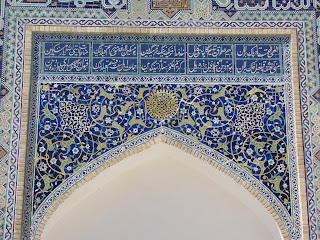


Under the Soviets it was used as a warehouse and reopened in 1991. Most of the area around here are being dug up and renovated. The whole outside was a mess of sand, gravel, stones and pavers. The new president is spending a lot of money in Samarkand and here.


We got a text to say our Beeline Uzbekestan telephone number had been disconnected. We have learnt to copy the SMS texts that come in Uzbek and have them translated by Google translator. We hunted out a Beeline shop and joined about 50 other locals with phone issues. I thrust the SMS text in front of the overworked salesman and after paying 6c per day for the next 20 days we were back on line with internet data to see us through the rest of our stay here. It is especially useful when using Google maps to get about, translate in shops, and to use when the internet is slow in the hotel. We have also learnt to tether the phone to the netbook as a mobile hotspot.
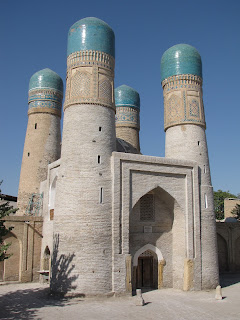

Char Minar, a gatehouse to a medressa that disappeared long ago. It was built in 1807.


The domes cool the interior of the bazaar.

Checked out a couple of carpet shops and got the salesman's gen on the differences between cotton and silk carpets and Japanese and Uzbek ones. There were some lovely huge carpets but it is such a complicated business to know which have been handmade and which have been made in factories in China. These things dictate the price so it can be costly for a novice. Everywhere you go someone is trying to sell you ceramic plates or embroidered fabric.

Met up with Jacky from Gran Canaries and found a restaurant with some vegetarian options for her. It ranked highly as a place to eat but we found it only had a small range of dishes but could at least enjoy the cool breeze on the top floor and a pleasant sunset. We have enjoyed getting to know more about her and her plans to go onto Nepal and then Bhutan before spending time in Vietnam and Myanmar.

The last emir of Bhukara, Emir Alim Khan, has a summer palace a short taxi ride from Lyabi Hauz. When we first arrived we couldn't believe it, it too was looking like a construction site. The receptionist was very chatty and seemed to know a lot about NZ from a TV documentary so we had a long chat with her.

Ceiling


Detail of the ceramic front of the fireplace.

The palace had a guesthouse, a harem and a pool. Russian architects designed it and it is a mix of styles. John was especially taken with the craftsmanship of the plaster work. There were many similarities with our hotel's breakfast room and the palace rooms which would have been about the same era. It was sad to see that they do not maintain the outside of the buildings as birds nest in the gutters and damaged timber work. There were lots of staff members keeping an eye on each room but some would have been better utilised working on maintenance to keep these treasures for the future.

The old city wall

We walked around the old town to see the remnants of the old city wall as well as the oldest building in the city being the Ismail Somani Mausoleum.


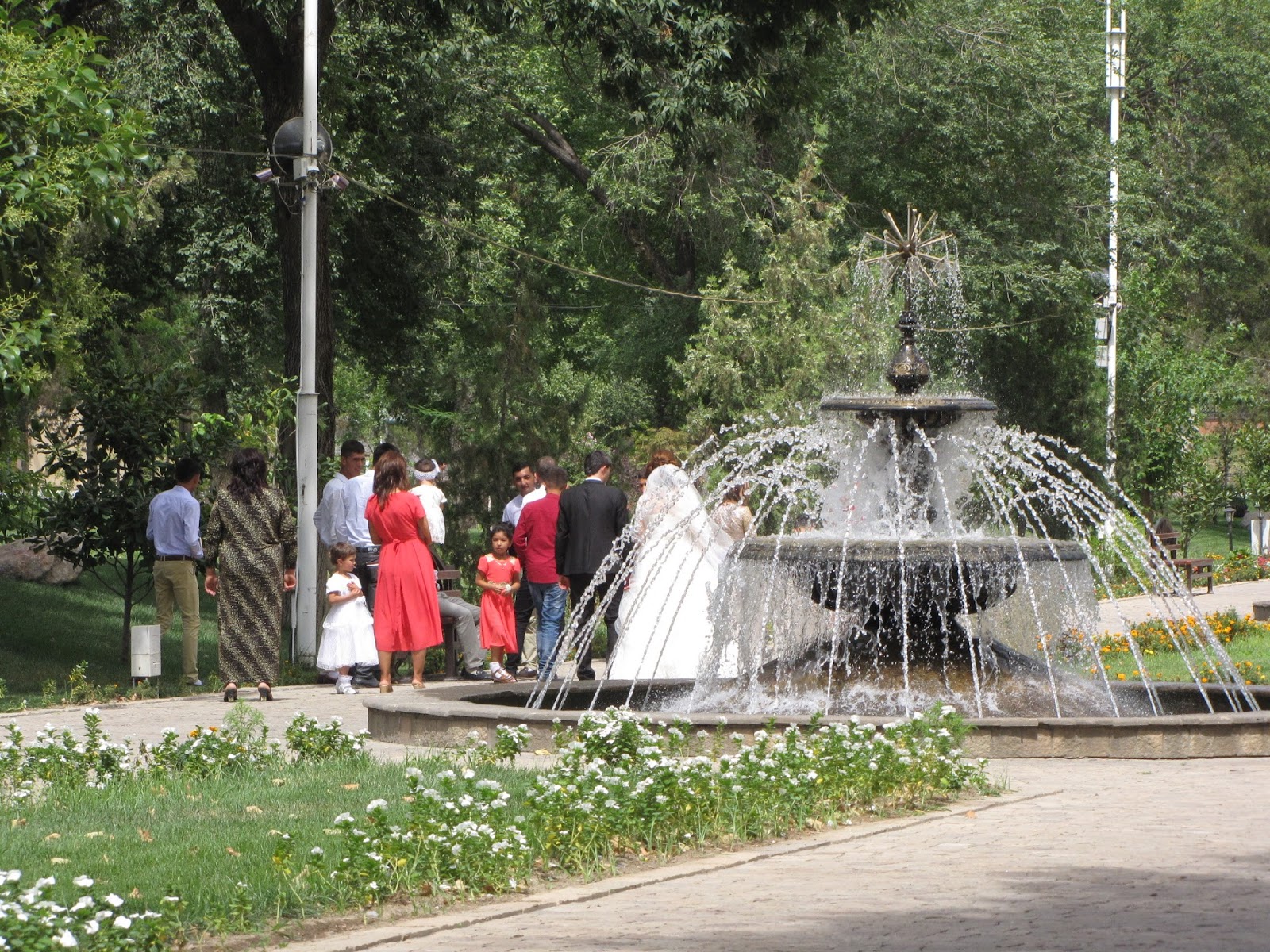
It was built in 905 and the patterns on the intricate baked terracotta walls are eye catching. It was situated in a children's park which in the 39 DegC heat of the day was very quiet. Other than the tourists, a small group of policemen ate at a table in the shade, and gardeners weeded and watered. It is nice to be able to spend a little of each day visiting sites rather than seeing everything in a couple of days like most of the tour groups.


Musical instruments for sale


A collection of Soviet badges for sale. We remember our first visit to the USSR in 1975 when the children would trade these for chewing gum.


Birds in cages outside the village houses.

Next stop  - further along the Silk Road to Khiva.


Samarkand, Uzbekistan

After an early breakfast in Tashkent and a short taxi ride, we were at the main railway station for our ride to Samarkand. We had expected a long wait at security for baggage checks but after the bags were x-rayed we were waved through. The Sharq, is an old Russian train but it was very comfortable with aeroplane styled seats and tray tables. Half the seats faced one forwards and the others back so there were four TV screens for the passengers to watch some local TV drama. Part way through a group complained about the sound being turned down and another group wanted it turned up. We were not allowed to photograph at the station or the train.

Out the window we could see a few towns with huge factories for storing grains. Some of the areas were lush from the irrigation while others had broken irrigation channels and looked very sandy and dry.

The four hour ride went quickly. When we arrived we zigzagged our way through the taxi mafia until we found a quiet taxi driver who quoted us half the rate the mafia did. They bunch up in the gateway and hassle you as a group. I can see how some tourists will just accept the overpriced offers for some peace. John had spent some time on line looking at blogs and articles about Samarkand so he could work out what was reasonable. The station was quite a way from the old city.

The B & B was in a quiet lane near the mausoleum of Amir Timur. It was a three storied wooden building with an open central area and lots of colourful wall hangings and carpets. Our room had two single beds and a bathroom with hot water pipes under the tiles so it dried out quickly after every shower. The aircon was efficient but the wifi was annoying to use as they had a different code for each device which you got on slivers of paper.


The breakfast however was wonderful with rock and watermelon, grapes and nectarines, three kinds of cheeses, salami, bread and jam, and rice or oat porridge. It was so nice not to have eggs every morning.

After some research on Tripadvisor we found a restaurant a few minutes walk away. It had a large outdoor area, a covered gazebo area and an indoor area with a dress code. The menu was huge and the food really lovely with beef and veal with cream and mushroom dishes. We have not seen anything like these dishes anywhere before in Central Asia. It also had local draught beer and it became our favourite restaurant for our whole stay until we found it closed one night and we had to find somewhere else to eat.


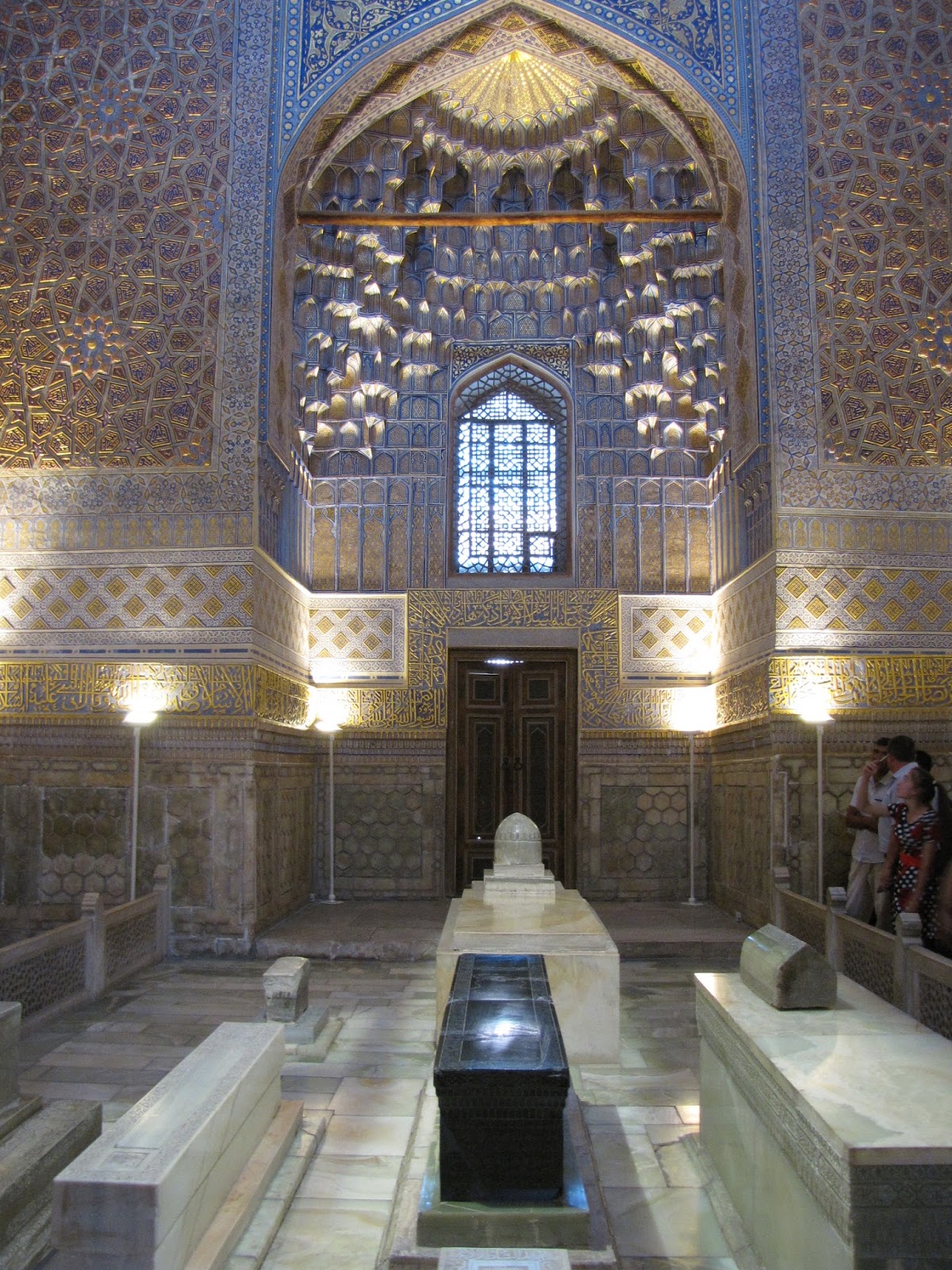
Everyday loads of buses and tourists would arrive to visit the Gur E Amir mausoleum. It contains the graves of the Uzbek hero Amir Timur, who died in 1405, his two sons and two grandsons. Tourists would return in the evenings to photograph the place its different moods. The local families would sit around the walls with their children to eat ice cream and cool off before bed.


Amir Temur Mausoleum 

Inside


                                                        At night

There were signs all over the city advertising the Sharq Taronalari Classical Oriental Music Festival to be held over several days at the famous Registan. The city was busy being painted, weeded, washed and repaved in time for the event. We had been told by other travellers that the Registan was closed as groups rehearsed for the event. It was frustratingly difficult to find out if tickets were available and when the Registan would be open to the public to visit. On the website there was no information about buying tickets. The festival was a competition with four prize groups and the grand prize was for $10,000US, with 31 countries participating including a group from Australia. One afternoon we saw streets blocked off and hundreds of police and plain clothed officials. We could not walk on the main streets and had to walk through back lanes in residential neighbourhoods. Black bullet proof cars sped through the streets taking the president and five other Republican state presidents to the festival.


There was a big screen on the corner opposite an intersection and we could see some of the presentations. Sadly there was no sound so we could not hear any of the music. When the camera showed some of the audience, they looked quite bored. It seems the show was for the elite. It ran for six days and the winners were a group from Azerbaijan. We later met a French couple who were offered tickets by a guard at the Registan. They were told to wait and were ushered to the front row VIP seats on the day after the president left.

Once the president had left, the Registan was open to the public from 11-4 when it once again closed for more rehearsals. The temperatures in the day are getting quite hot above 33 degrees by early afternoon. The Registan contains three madrases, educational institutions, the world's oldest. The rooms were used for classrooms and dormitories. Chingis Khan destroyed older ones. The buildings were rebuilt in Soviet times. In the public space royal proclamations and executions were held. On our visit it was set up with speakers, props and lighting from the festival.


The beautiful gold fluted ceiling


Beside our favourite restaurant was a small stadium where rehearsals were being held every evening for the Independence Day celebrations on September 1st. We met a group of ballet dancers after their practice run and they were very excited to be in the celebrations. We could hear marching music for the soldiers as well as traditional songs.

One day we caught a local bus to the huge Siob bazaar in an older part of the town. A few elderly people sat on the footpaths begging from bazaar visitors. A new stainless steel walkway was being installed over the four lane road below and we were not allowed to cross so had to ignore the whistles from the police as we skipped through the grass verges past the trademen cutting paving to reach the road to the Afriosab Museum. On the other side was the Hazrat-Hizr mosque which was built in the 8th century but burnt to the ground by Chengis Khan. It was rebuilt in 1854 and then restored by a wealthy Bukharan in 1990s. It was closed to visitors as it was being titivated for the anniversary of the previous prime minister's passing.

The Afrosiab museum houses treasures unearthed during excavations in 1965. The most interesting was a 7th century fresco showing the Sogdian King Varkhouman receiving ranks of foreign dignitaries astride camels, horses and an elephant. There was also an excellent film made by the French animating the fresco figures to show what they would have been doing at the time.

On our way back from the museum we could not ignore the police again and they sent us off through the cemetery to get back to the bazaar. A lot of the modern headstones have beautifully etched portraits of the deceased. There were lots of quite dark-skinned women and children in the cemetery washing down the marbled graves for money. Part of the cemetery was for Jewish graves. There are about 50 Jewish residents in Samarkand, with numbers decreasing all the time.

We were impressed with all the medals this                                   man had.

A newly paved and well laid out walkway area led us to the Bibi Khanym mausoleum and  mosque which was pretty busy with tourists photographing them from all angles. Lots of new souvenir shops lined the walk way and continued on to pass by the Registan. A lot of money has been spent on developing the area for tourism.


Some of the detail on the Bibi Khanym                                         mosque
The evening before the Independence Day celebrations saw some of the streets by the rehearsal stadium closed and swarming with soldiers. We also heard from a Polish couple who had read on their Polish news that there had been about 3700 people arrested in Urgench, in the west of the country. It seemed they were held for 'walking aimlessly' at night. One poor man had been told by his doctor that he needed to walk more as he had heart disease. He found it too hot during the day so walked at night and got locked up. Apparently, the local police were a bit anxious prior to the celebrations and unlawfully arrested these people. He was later charged with having no ID on him. We religiously carry our passports and registration slips from our accommodation but as yet have never been asked for them.


Next stop further along the Silk Road - Bukhara ,Uzbekistan


Tashkent, Uzbekistan

Our guide book warned us that the crossing to Uzbekistan would take a long time and we would need to prepare well. We were told there are several banned medications in the country and when we looked at the website to see what they were -there were 200! We listed all ours and their uses to make life easier. We were also warned that they would look at our photos to be sure we did not have any pornography or photos they deem unacceptable. We had to fill in a declaration of how much money we have and they kept one form and we have to present the other when we depart. At the border they were not even interested in looking in our bags so we passed through in no time.

Patient John was able to grind the taxi driver down to a reasonable rate to drive us to Tashkent an hour and a half from the border. We ended up with a Tajikistan man joining us. He worked in China for a company making leather jackets and was heading for the airport in Tashkent.

It was instantly noticeable that Uzbekistan has a better economy than Tajikistan. There was a well constructed double lane road and lots of new and partly constructed two storey buildings along the side of the road. The shops were well made of baked brick and with modern pvc double glazed windows. The place was buzzing with builders.

The green plains between towns were mainly cotton plantations with food crops filling smaller spaces between the huge fields. Like all through Central Asia the locals had their melons, sweet corn and vegetables stacked up on the side of the road for sale. Often there would be a steel bed nearby where they would take a nap between sales or weeding and harvesting. Their animals would be tethered nearby eating available grass along the drains and road edges. We did pass some huge plastic growing houses with hydroponics and solar panels that looked very impressive.

John had to use the phone map to direct the driver around the old city roads to our bed and breakfast near the old bazaar of Chor-su. The place only had a small sign on the gate and no other signage on its huge steel door. We had booked a double room with air con and an ensuite but the owner informed us there had been some problem with the room and we would have to take a bed in the dorm room with three others for the night. That was fine by us and we shared with a young French English teacher and his 79 year old grandmother. They had been 40 days in Central Asia visiting every antique, silk, ceramic and carpet shop or factory that they could find. They had bought so much stuff that there were bags everywhere in the small shared room.

The B n B owner Mirzo entertaining us on his datur- two stringed traditional instrument, one evening.

The other person in the room was Anna from Italy and she was trying to get a transit visa to continue onto Tajikistan. She had been to the embassy the day we arrived in the city and was going back the next day. We have heard from several travellers about how difficult it is to get a visa for Turkmenistan. They offer 3 day or 5 day transit visas. If you want a longer stay you have to book a tour and have a guide. We found a Turkmen travel agency online who firstly issued us with a LOI which is a Letter of Invitation. We then had to book a tour with them as they were one of several government approved tour companies whom you could book through.  We booked with them and are are now going to the 5th Asian Indoor and Martial Arts Games in Ashgabat. Once the LOI was paid for we had to join Anna in the queue at the Turkmen embassy to pick up the visa. Ours was issued on the spot but Anna's was rejected as they are no longer issuing transit visas. Of course they want visitors to take a guide and a tour and they are promoting the games as being bigger than Beijing's opening and closing ceremonies.

             $100 US dollars in Uzbek somoni!

Uzbekistan has a dual currency or official and black market rates for Euro or US dollars. The B and B owner changed our dollars for 1: 7700 against the official rate of 1:4500. All accommodation must be paid in US dollars so all travel, food and other things we can pay in somoni. We later changed a hundred dollars at the market and got it all in 1000 somoni notes which took up a lot of space in our backpack. It reminded us of when we used the Bolivian black market to convert dollars to peso to buy airline tickets and they filled a big backpack!
 
Getting about the city has been easy on the metro. We had to buy a plastic token for each journey. Guards checked our bags on entering the subway and then again before entering the turnstile. Photos cannot be taken of the inside of the metro as they are deemed to be military installations. Each station has a different theme and they are decorated with glazed tiles and domed ceilings. The glazed tiles are works of art. The platforms are old but spotlessly clean. There is advertising on the walls of the escalators, but none on the platforms other than advertisements on a tv screen. One night we saw an Asian tourist take photos and in no time a guard and policeman arrived to get him to delete them. There are security cameras everywhere. The lines are not very far underground and at times we have felt the trains rattling under the footpaths as we walk above ground. We felt very old travelling the metro because every time we entered a carriage the locals, both men and women, would give up their seats for us.

One night we met a Couchsurfer called Yulduz. She responded to our public message to meet up. She is a 22 year old Uzbeki student learning Korean and playing the Korean drums in her spare time. We met at a Turkish restaurant that had three floors for dining and an outside garden area with its own children's playground. I doubt there is one like it in NZ. She also invited Jacky, an English woman who lives in the Gran Canaries. Jacky told us about her very interesting trip in a Russian icebreaker to the North Pole. They could not get off right at the pole as there were polar bears nearby.


Another night we met with Farruh who had invited us to stay with him. Unfortunately Uzbekistan has a rule that means all guests have to be registered and you cannot be registered in a private home. (Well, not easily). We caught up with him in a park and ate at a Russian restaurant. He recently returned from studying in the Uk where he did a masters. He is an English teacher. He also did some travelling for a year and a half and taught English in Mexico. He wants to travel more but has the responsibilities for his retired mum who has had a hip operation and for his younger sister who is studying, because his dad died in his 40s. We called him the Uzbek hippie. He teaches his students at a table in the restaurant even though he has been offered work at friend's schools, as he wants to do his own thing.


Farruh was most surprised at the changes to Tashkent in his year and a half overseas. There are streets of bars, cafes and classy European looking restaurants with outdoor seating and even water misters to cool the guests.


The lively Russian restaurant.


One day we went exploring and found a city tour bus by chance. It was not listed in the top 10 things to do in Tashkent or on posters anywhere. The upper deck of the bus had an area that was airconditioned and a part that was open. We toured all the main sites for two and a half hours stopping at some to walk around and take photos.


Amir Timur on his horse. A Muslim military leader, born in the 1320s. Under the Soviets he was a villain but the Uzbeks see him as a hero and honour him.


The city was hit by a huge earthquake in 1966, leaving 300,000 homeless.

This monument to the Russians who helped rebuild the city after the 1966 earthquake. 20% of the houses built were given to the Russian volunteers, much to the annoyance of the city's residents causing street brawls.

Our guesthouse was in the old city where there are still mud brick homes and narrow lanes.


This is part of the huge Chor-su bazaar just down the road from our B n B. It is also where we would
find money changers with their black plastic bags of money. The place is enormous where you can buy anything you need. We got caught in the frenzy of produce arriving in the early morning and stall holders bargaining and choosing their day's fruit and vegetables. Absolute chaos. When we returned late in the evening we would walk through stalls closed up covered with sheets and local stall holders asleep on the ground or on their trolleys, but the grounds would be swept and clean.


A monument and park with the Museum of the Victims of  Political Supression in memory of those who died under Stalin.

Part of the city is leafy with lots of parks and modern stores and called the European section while part is noticeably Russian era with tall blocks of residences.


The new white mosque where we saw a funeral taking place.


Independence Square/park was closed to the public as the structures were washed and the gardens replanted and watered. Sept 1st is when Uzbekistan celebrates 26 years of independence from Russia so there will be big parades.


Storks above the gate to Independence Park. We were unable to see the statues of the Crying Mother, honouring the 400,000 Uzbek soldiers killed in World War 11.

One day we went inside the TV tower to get a view of the city but being a military structure we were unable to take photos of the view.


We spent a hot day cooling off at Alisher Navoi National Park  - he was a poet from 1441-1501.


In the dome above his head is written ' Know all human kind: The greatest curse in enemity: The greatest blessing is Amity.'

The park is huge with canals, where we saw teen boys jumping off the bridges and racing each other, kids with their parents on the funfair rides, and courting couples in the shade of the conifers. The park houses the House of Representatives, the Wedding Palace and the Istiklol Palace. It is wonderful how much green space the city has.


The art gallery.


The brides love the Cinderella dresses and this one had a lot of trouble getting her dress into the waiting stretch limo.

We have enjoyed the restaurants and food in Tashkent. If only the other places in Central Asia could learn from their restaurants.


Khojand Tajikistan

The hotel owner organised a shared taxi to meet us at our hotel after breakfast which was really great. He insisted I sat in front with the driver. Our bags were tied to the roof rack on top and we headed out of town for about half and hour where we stopped at a farm house to pick up loads of sacks of produce and three passengers. We didn't get very far before one of them had motion sickness.

When our guide book was written the road was bad but we found it very smooth and fast. Rather than landslides and potholes these were the hazards.

We wound through some small villages in the valleys beside the road. If a spring ran down the rock then milk, kefir and soft drink bottles were lined up under the cool water to keep them chilled. If the pipes ran into the drain outside houses then women washed their dishes and clothes beside the drains on the edge of the road. It seemed odd to see someone fill up an electric jug from the pipe over the drain meaning they had electricity in the house but no running water.

We drove through a long curved tunnel and when we came out the other side the geography changed from mountains and valleys to plateau. The small hills had small bushes and dry grass while the plains had miles and miles of cotton plantations as well as other food crops.
The new bazaar building

Khojand is the richest and second largest city in Tajikistan. There is not much to see here either. We spent some time in the main square people watching. It was the only place in the whole of Central Asia where we saw drunks. A small group of drunk old men were arm wrestling on a bench not far from us.

Photographers with big cameras hounded any families or young couples to have their photos taken and within 20 minutes the poor quality prints were ready for pick up.

All sorts of electric children's vehicles were for hire and this guy looked very pleased with his choice of tank.
Bread seller
We watched a poor frazzled mum with her son who looked like he had some kind of syndrome. He  threw about three tantrums as she would not let him get on the motorbikes. He lay on the ground screaming, threw stones at his mum and ran off and helped himself to a bike. The business owner got him off and when he was distracted with a new little customer the boy started up another bike and headed off. A man sitting on the same bench as us felt sorry for the boy and paid for him to ride the bike. After the boy got off he jumped into the sidecar of a bike that another kid was riding and never gave up trying to find another way he could keep riding.


When in Dushanbe we met a Dutch woman who works in Tajikistan helping apricot growers. She gave us a contact in Khojand for a man who had rented her an apartment. We contacted the guy and met him when we arrived. He took us to an apartment near the bazaar. It is in an old Soviet era block. 

We are on the third floor and have a white balcony. We have managed to find a supermarket and organise food for ourselves. John has been able to take some antibiotics and recover from his diarrhoea.

Visited the citadel which was the site of Alexander the Great's original settlement. The fort's mud walls have eroded away in the background and the foreground shows the rebuilt walls housing the museum.


 The Cultural and Historic Museum.


  In the lower floor of the museum is a whole room dedicated to Alexander the Great. A local artist has used different coloured stone in the mosaic display showing Alexander's life. This scene shows him being instructed by Aristotle


Another scene shows him marrying a Tajikistan woman and tin the final scene he has died aged 33.


Surrounding the area is a lovely park which is popular for brides to visit for photographs.


 Outside the park was this statue and after some research I see we have one in Hamilton at the Hamilton gardens as well.


Next stop

Tashkent Uzbekistan.


Penjikent, Tajikistan

The hotel we chose in Penjakent was really great. The owner designed the larger rooms against his architect's advice so we were able to enjoy the space for our three day stay. The wi-fi was erratic but we could automatically switch from it to our phone data and run our netbook on our mobile hotspot. We have learnt a lot about this sort of technology over time.

There is not a lot to see in Penjikent but we needed somewhere to wait for our Uzbekistan visa entry date to click over. When we organised the visa early in the travels we did not know how much time we would need for each country.

 Somoni 

Fifteen  kms outside of Penjikent are the ruins of Sarazm, a 5500 year old site and one of the oldest city sites in Central Asia. It was the largest metallurgical center where turquoise was obtained from nearby sources. It later became an important agricultural region and both wheat and barley grains were discovered from the site. A farmer found a dagger sticking out of the ground in 1976 and a Russian archaeologist and a French team excavated it in 1977. As they are now only ruins, and we had seen the findings in the Dushanbe Museum, we decided not to bother to visit the UNESCO listed sight.

We visited the local Radaki Museum and were shown around the exhibits by a local woman who was told by her school that she needed the English speaking practise. She really just read out the signs already on the exhibits ' ceramic vessel', 'terracotta vessel'. However we were at least able to ask some questions about the exhibits.There were lots of replicas of the findings from Sarazm including some of the wall murals and a burial grave of a wealthy woman with her lapis beads and seashell bracelets. The woman stayed with us around the eight rooms and when we got back to reception the souvenir stall holders were hanging out for us to leave so they could go to lunch.

We ate at a cafe recommended by the hotel owner but the meals lacked variety. The beefsteak was a minced meat patty served with spaghetti, mashed potatoes, kibbled wheat and topped with an egg. Stroganof, was tenderly stewed bits of beef, served with exactly the same accompaniments and a lot of oil. John, the meat eater, went for the shish kebab options with raw onions. Unfortunately after our last meal here John ended up with terrible diarrhoea.

 Lenin

We walked around the city a couple of times visiting the parks and back streets. We saw a huge construction site and the sign said it would be a school and the drawings looked impressive. An old Soviet era fire engine rushed to a house fire one day while we were out and had it out in no time. The local stadium was being renovated near the river and looked a long way from finishing.


The new style of apartments alongside the Soviet era apartments.


We often see vehicles from Europe still with their country of origin advertising. This had a Tajik registration.


We often see locals putting their cash into these machines, as it is where they can pay for their telephone, internet, gas, electricity, loans and other expenses. They would never work at home as they would get stolen for the cash.

We took the time to catch up on correspondence, pay bills, and catch up on accommodation reviews and update the blog.

Next stop Khojand, Tajikistan


Singapore

The Singapore Airlines flight was quite bumpy and after seven and a half hours we arrived in Singapore surprisingly earlier than expected. ...