We were unable to get a train ticket from Astana to Shymkent as they were all booked out. Either they were taken by students returning from studies, visitors to the Expo or scalpers. We managed for a few dollars more to get a flight with Air Astana and arranged to be picked up in Shymkent by the hostel taxi driver at the airport.
The first impressions were of a noisy, dusty, chaotic city as we weaved through the traffic to get to the hostel. The taxi driver had to manoeuvre out of the way of a car on his outside and hit the side of a bus snapping his wing mirror inwards. The driver sped off to catch up with the offender at the lights and they yelled at each other until the lights changed colour. We had had a similar experience in Almaty when the bus we were in pulled out from the stop and a car jammed up to the side of the bus as it tried to beat the bus moving from the stop. Both drivers yelled at each other and the passengers must have asked to open the bus doors and along with others we left them to debate the issue and luckily only had a short walk to home base.
 Nina
The hostel we had booked was a family home converted. We were the only guests and the owner Nina did not speak much English but with Google translator we were able to get all the information we needed. Interestingly, Nina's son Valeriy had spent two years studying English and cooking in NZ and had worked at a backpacker's hostel in Auckland. When his mum and dad divorced he thought it would be a good idea to turn Nina's home into a hostel to give her some extra income above her small pension and allow her to stay in the family home and the neighbourhood with her friends. It has been running since November so it is still early days for them but it keeps Nina from being lonely.
 Kazaks have good backs as they sleep on such thin mattresses. Nina gave me some blankets to go on top of the mattress to save my sore hips!
Valeriy is only a phone call away when Nina needs language support and he lives not far with his wife and baby. When he popped in we were able to get directions from him for the local shashlik (skewered meat) restaurant. After he left Nina made us some pancakes so we didn't need to eat but headed off to enjoy some locally made draft beer and a look around the area. The restaurant was real really busy and they seemed to have problems with their extractor fans removing the smoke from the shashlik charcoal burners. The staff were in and out catching their breath as takeaway orders flooded in and people queued outside for them.
The locals like to dine in groups and they order so much food, mostly grilled lamb, beef and horse. They have very little salad dishes and no other vegetables but piles of different kinds of bread. That must count as a vegetable!
It is a lot hotter in Shymkent than Astana and we opted for a larger room with 4 bunks rather than the smaller double room we were allocated as it was cooler for sleeping.
We have found the 2GIS app that a UNESCO volunteer told us about in Almaty to be really useful as it works offline and gives us the bus routes and bus stops to all the places we want to go to. It makes life so much easier than lugging maps around. We don't feel conscious that we are displaying our phone or that it could be at risk of being stolen. Everyone is yakking on their phones and taking selfies and they carry their phones conspicuously in their back pockets or open handbags. I doubt you would have a phone in NZ if you did that!


We visited a memorial park where lots of students were spending their break time in the shade of the trees and catching up with their friends. There were rows of tanks on stone pillars, a Russian MIG jet with bombs attached. 140,000 Southern Kazak citizens who lost their lives in WW2 had their names etched in two rows of plaques in front of the jet. It was chilling to see. The place was pretty well maintained and well used.

We walked onto another park that was surrounded by cafes and restaurants near government buildings. There were lots of children's play areas and parents with their toddlers. It comes alive at night apparently and is named after a well known musician.
There is not much else to see and do in Shymkent that we could find but enjoyed walking around the tree-lined streets.We visited the shashlik restaurant again and found it had installed overhead misters spraying fine water mist to keep the dinners cool and frizz their hair. We could see the shashlik cooks and it looked like they had repaired the extractor fans.
Even though it is Ramadhan the restaurant was full. It is popular for the young men to smoke shisha pipes while they eat and an employee works full time heating up the ashes waiting for orders. As he waits he puffs away creating rows of smoke circles to pass the time.
We used our Google translator to identify some of the menu items but were confronted with dishes called Money, Mystery, Zebra, Coins and Panda. The translator switches on a camera that scans the text and translates at the same time. It is really useful but did not help us when they call their dishes such obscure names. In the end we Googled 'beef ' and got the waiter to show us which dishes were beef and ordered them. We chose Zebra and discovered it was thin slices of marinated beef alternating with thin slices of beef fat, making sense to call the dish Zebra!
We caught a local bus to the Samal bazaar and bus station where we waited for a marshrutka (minivan) to fill up with 12 people. Passengers bagged their seats with hats or plastic bags of food and after about 40 minutes we were ready to head off to Turkestan, 165 kms away.
On the outskirts of Shymkent we passed many huge modern buildings with grand pillared entrances. We later learnt that they are used for Kazak wedding venues as they may have 400-500 guests!
The road was a newly formed motorway but many parts were under repair so the minivan swayed back and forth across the lanes when the road was closed with rocks and tree branches. It was quite unnerving watching the traffic come towards you in the same lane.


Turkestan is a Muslim pilgrim site and is UNESCO listed. It contains the mausoleum of the first great Turkic Muslim holy man Kozha Akhmed Yasaui which was built by Timur in the 14th century. Timur died and the mausoleum was never finished. The back is covered with beautiful tiles but the front lacks them. Bits of timber scaffolding stick out of the brick work providing a roosting perch for the smelly birds. Rusting modern steel scaffolding creeps up one side of the entrance ready for more renovations. Some of the old streets and a part of the fortification wall have been renovated and we walked about that. It was a hot 34C day and very little shade so we headed off to find a marshrutka back to Shymkent.
 You could have your photo taken on this camel or with a poor peacock at the mausoleum.
We arrived back to meet three Chinese motorcyclists and a couple of Russian guests. The young Chinese man told us he was an industrial engineer working with robotics. His company had no more work for him so he got a redundancy payout and with his wife as pillion and her uncle on a second motorbike they left Beijing to head for Europe. They slept the two days they were in the hostel as they were so tired. He said he would ride his bicycle 200 kms a day but he could only manage 100 kms a day by motorbike as it was quite stressful riding in the traffic where commuters are not used to motorbikes. He is hoping he can get work in Australia if things do not pick up in China.
They have got used to seeing us at the shashlik restaurant and no longer serve my beer with a straw! We have also got better at getting the waiters to understand what we want. Luckily there are photos of some of the dishes on the menu so we can always point to them if it gets too much. The restaurant fills up after 9.00 pm as that is when the fasting for Ramadhan is over and people can eat again. They have to eat before sunrise and after sunset with nothing else at all all day.

We researched a trip to a Nature Reserve and with Valeriy and Nina's contacts we were able to book into a reasonable guest house where they would provide us with meals. Valeriy invited us to dine with him at the shashlik restaurant and we met his baby and wife Alyona. They have set up a restaurant to prepare Korean food and currently do take away orders and will expand the restaurant over time. Alyona is from Uzbekistan and previously worked in Moscow. They converse in Russian and Valeriy does not know much Kazak, nor see the value in the language.

After the meal we went by taxi to a new park which was busy with families and young couples. There were fountains and a huge ferris wheel called Altyn Eye (Golden Eye). it was a lovely atmosphere with ice cream sellers and gardens and fountains.

The car park was full being 10 pm at night. Families seem to keep their children up really late here. We often think about how such places would fare in NZ. We saw no graffiti, no young drunks, and no loud hoonish behaviour. We were home at midnight after a fun time with the Kim family.


 Next stop Zhabagyaly.
The first impressions were of a noisy, dusty, chaotic city as we weaved through the traffic to get to the hostel. The taxi driver had to manoeuvre out of the way of a car on his outside and hit the side of a bus snapping his wing mirror inwards. The driver sped off to catch up with the offender at the lights and they yelled at each other until the lights changed colour. We had had a similar experience in Almaty when the bus we were in pulled out from the stop and a car jammed up to the side of the bus as it tried to beat the bus moving from the stop. Both drivers yelled at each other and the passengers must have asked to open the bus doors and along with others we left them to debate the issue and luckily only had a short walk to home base.
 Nina
The hostel we had booked was a family home converted. We were the only guests and the owner Nina did not speak much English but with Google translator we were able to get all the information we needed. Interestingly, Nina's son Valeriy had spent two years studying English and cooking in NZ and had worked at a backpacker's hostel in Auckland. When his mum and dad divorced he thought it would be a good idea to turn Nina's home into a hostel to give her some extra income above her small pension and allow her to stay in the family home and the neighbourhood with her friends. It has been running since November so it is still early days for them but it keeps Nina from being lonely.
 Kazaks have good backs as they sleep on such thin mattresses. Nina gave me some blankets to go on top of the mattress to save my sore hips!
Valeriy is only a phone call away when Nina needs language support and he lives not far with his wife and baby. When he popped in we were able to get directions from him for the local shashlik (skewered meat) restaurant. After he left Nina made us some pancakes so we didn't need to eat but headed off to enjoy some locally made draft beer and a look around the area. The restaurant was real really busy and they seemed to have problems with their extractor fans removing the smoke from the shashlik charcoal burners. The staff were in and out catching their breath as takeaway orders flooded in and people queued outside for them.
The locals like to dine in groups and they order so much food, mostly grilled lamb, beef and horse. They have very little salad dishes and no other vegetables but piles of different kinds of bread. That must count as a vegetable!
It is a lot hotter in Shymkent than Astana and we opted for a larger room with 4 bunks rather than the smaller double room we were allocated as it was cooler for sleeping.
We have found the 2GIS app that a UNESCO volunteer told us about in Almaty to be really useful as it works offline and gives us the bus routes and bus stops to all the places we want to go to. It makes life so much easier than lugging maps around. We don't feel conscious that we are displaying our phone or that it could be at risk of being stolen. Everyone is yakking on their phones and taking selfies and they carry their phones conspicuously in their back pockets or open handbags. I doubt you would have a phone in NZ if you did that!


We visited a memorial park where lots of students were spending their break time in the shade of the trees and catching up with their friends. There were rows of tanks on stone pillars, a Russian MIG jet with bombs attached. 140,000 Southern Kazak citizens who lost their lives in WW2 had their names etched in two rows of plaques in front of the jet. It was chilling to see. The place was pretty well maintained and well used.

We walked onto another park that was surrounded by cafes and restaurants near government buildings. There were lots of children's play areas and parents with their toddlers. It comes alive at night apparently and is named after a well known musician.
There is not much else to see and do in Shymkent that we could find but enjoyed walking around the tree-lined streets.We visited the shashlik restaurant again and found it had installed overhead misters spraying fine water mist to keep the dinners cool and frizz their hair. We could see the shashlik cooks and it looked like they had repaired the extractor fans.
Even though it is Ramadhan the restaurant was full. It is popular for the young men to smoke shisha pipes while they eat and an employee works full time heating up the ashes waiting for orders. As he waits he puffs away creating rows of smoke circles to pass the time.
We used our Google translator to identify some of the menu items but were confronted with dishes called Money, Mystery, Zebra, Coins and Panda. The translator switches on a camera that scans the text and translates at the same time. It is really useful but did not help us when they call their dishes such obscure names. In the end we Googled 'beef ' and got the waiter to show us which dishes were beef and ordered them. We chose Zebra and discovered it was thin slices of marinated beef alternating with thin slices of beef fat, making sense to call the dish Zebra!
We caught a local bus to the Samal bazaar and bus station where we waited for a marshrutka (minivan) to fill up with 12 people. Passengers bagged their seats with hats or plastic bags of food and after about 40 minutes we were ready to head off to Turkestan, 165 kms away.
On the outskirts of Shymkent we passed many huge modern buildings with grand pillared entrances. We later learnt that they are used for Kazak wedding venues as they may have 400-500 guests!
The road was a newly formed motorway but many parts were under repair so the minivan swayed back and forth across the lanes when the road was closed with rocks and tree branches. It was quite unnerving watching the traffic come towards you in the same lane.

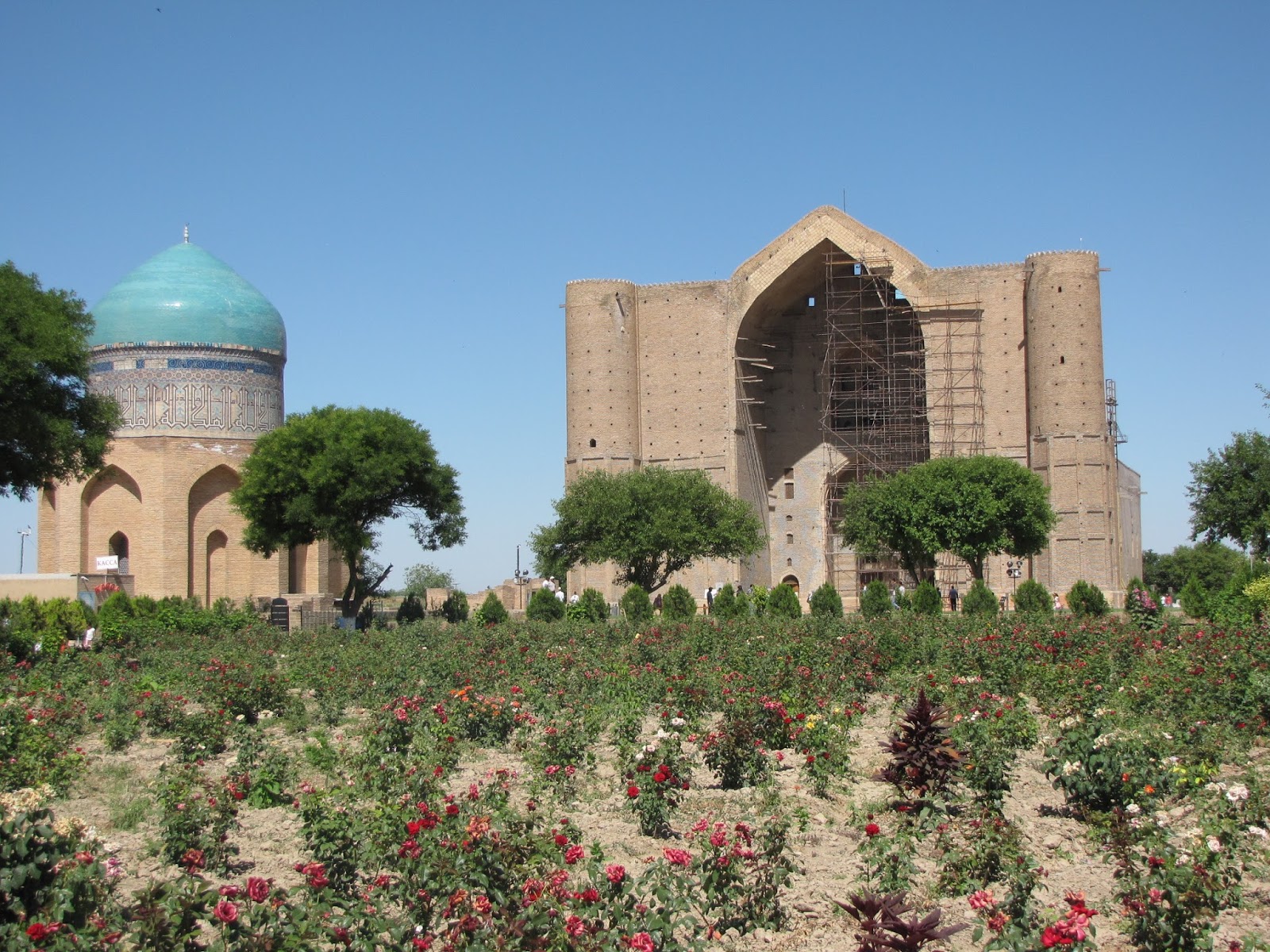

Turkestan is a Muslim pilgrim site and is UNESCO listed. It contains the mausoleum of the first great Turkic Muslim holy man Kozha Akhmed Yasaui which was built by Timur in the 14th century. Timur died and the mausoleum was never finished. The back is covered with beautiful tiles but the front lacks them. Bits of timber scaffolding stick out of the brick work providing a roosting perch for the smelly birds. Rusting modern steel scaffolding creeps up one side of the entrance ready for more renovations. Some of the old streets and a part of the fortification wall have been renovated and we walked about that. It was a hot 34C day and very little shade so we headed off to find a marshrutka back to Shymkent.
 You could have your photo taken on this camel or with a poor peacock at the mausoleum.
We arrived back to meet three Chinese motorcyclists and a couple of Russian guests. The young Chinese man told us he was an industrial engineer working with robotics. His company had no more work for him so he got a redundancy payout and with his wife as pillion and her uncle on a second motorbike they left Beijing to head for Europe. They slept the two days they were in the hostel as they were so tired. He said he would ride his bicycle 200 kms a day but he could only manage 100 kms a day by motorbike as it was quite stressful riding in the traffic where commuters are not used to motorbikes. He is hoping he can get work in Australia if things do not pick up in China.
They have got used to seeing us at the shashlik restaurant and no longer serve my beer with a straw! We have also got better at getting the waiters to understand what we want. Luckily there are photos of some of the dishes on the menu so we can always point to them if it gets too much. The restaurant fills up after 9.00 pm as that is when the fasting for Ramadhan is over and people can eat again. They have to eat before sunrise and after sunset with nothing else at all all day.

We researched a trip to a Nature Reserve and with Valeriy and Nina's contacts we were able to book into a reasonable guest house where they would provide us with meals. Valeriy invited us to dine with him at the shashlik restaurant and we met his baby and wife Alyona. They have set up a restaurant to prepare Korean food and currently do take away orders and will expand the restaurant over time. Alyona is from Uzbekistan and previously worked in Moscow. They converse in Russian and Valeriy does not know much Kazak, nor see the value in the language.

After the meal we went by taxi to a new park which was busy with families and young couples. There were fountains and a huge ferris wheel called Altyn Eye (Golden Eye). it was a lovely atmosphere with ice cream sellers and gardens and fountains.

The car park was full being 10 pm at night. Families seem to keep their children up really late here. We often think about how such places would fare in NZ. We saw no graffiti, no young drunks, and no loud hoonish behaviour. We were home at midnight after a fun time with the Kim family.


